Author: admin

  • Gender Criticism vs. Gender Abolition

    The following is an essay originally commissioned by a UK broadsheet in August 2022.


    Woman? Very simple, say those who like simple answers: She is a womb, an ovary; she is a female: this word is enough to define her.

    — Simone de Beauvoir

    With a pamphlet entitled “Children, Idiots, Women, and Minors” (1868), the Victorian polemicist Frances Power Cobbe embarked on a campaign to persuade the emerging movement for women’s rights that any attempt to define women on biological grounds would lead to idealism and abstraction. “We must not fall into the absurdity of supposing that all women can be adapted to one single type, or that we can talk about “Women,” (always to be written with a capital W) as if the same characteristics were to be found in every individual species.”1 Cobbe’s point was that the category “women” was a legal fiction, which empowered men to deprive a class of their fellow human beings of legal and civil rights. Like workers in Victorian factories, women may share little beyond their social rank––some, of course, may be slotted into patriarchy on the basis of their supposed fertility; while others could have been placed there to perform other kinds of reproductive labor. The connection between women was neither biological nor absolute, but derived from their position in society.

    Cobbe’s idea was not uncontroversial at the time it was written. But by the end of the nineteenth century, it had become ubiquitous among women’s rights campaigners. Demands for women’s suffrage were rooted in the notion that “women” were not a naturally-occurring type, distinguishable from men on natural grounds, but simply a group of person that had been denied legal parity. Josephine Butler, an important early suffragist, wrote in 1869 that “the term ‘Women’ is a large and comprehensive one,” and argued that it is specifically in relation to work that the class that bears that title had come into being; accordingly, her collection of essays on the theme of women’s emancipation was not titled like John Stuart Mill’s rather grandiose The Subjection of Women, but in respect of the lives and labors of those whom Butler sought to uplift: Women’s Work and Women’s Culture.

    In the post-war feminisms of the twentieth century, the notion that “women” was a social category, rather than a naturally-occurring type, became rather more fraught, not least because the institutionalization of evolutionary theory seemed to confirm that, though perhaps “man” and “woman” were social types, nonetheless “female” and “male” attributes were relatively similar across all mammalian species. So when Simone de Beauvoir famously argued that “one is not born, but rather becomes, a woman,” the object of her critique was not patriarchy, but biology. The following sentence reads: “No biological, psychological, or economic fate determines the figure that the human female presents in society.” Beauvoir’s feminism depended on a refusal of the notion that different sex characteristics produced differently-sexed organisms, and that while biological traits could be sexed, whole people can’t in any reliable or comprehensive way.

    The existence of heterogenetic gametes alone does not necessarily mean there are two distinct sexes; the differentiation of reproductive cells often does not bring about a division of the species into two types: both can belong to the same individual. This is true of hermaphroditic species, so common in plants, and also in many invertebrates, among which are the annulates and mollusks. Reproduction takes place either by self-fertilization or by cross- fertilization. Some biologists use this fact to claim the justification of the established order. They consider gonochorism—that is, the system in which the different gonads belong to distinct individuals—as an improvement on hermaphroditism, realized by evolution; others, by contrast, consider gonochorism primitive: for those biologists, hermaphroditism would thus be its degeneration. In any case, these notions of superiority of one system over another involve highly contestable theories concerning evolution. All that can be affirmed with certainty is that these two means of reproduction coexist in nature, that they both perpetuate species, and that the heterogeneity of both gametes and gonad-producing organisms seems to be accidental. The differentiation of individuals into males and females thus occurs as an irreducible and contingent fact.

    So, according to Beauvoir, sex is differentiable at the scale of the cell, but since there exist organisms in which sex-cells of both sexes are found, we therefore cannot use the fact of sexual dimorphism as a basis for the sexual classification of individuals or groups. It is not that Beauvoir refuses to talk about female organisms altogether––she does so frequently––it is that such organisms are inferred, rather than emerging into the world fully-formed. “Assigned at birth,” if one likes––or before, or after. Femaleness “irreducible and contingent,” in Beauvoir’s beautiful, enigmatic phrase.

    Beauvoir’s answer to the apparent problem of evolutionary biology was widely embraced by feminists in Europe, the United States, and the United Kingdom, with some lesbian feminists going so far as to argue that the term “woman” was no longer relevant to feminist organizing; Monique Wittig, infamously, declared that “a lesbian is not a woman”––meaning that there was no basis, biological or social, on which those placed into sexual passivity and reproductive labor by compulsory heterosexuality could be said to share interests with lesbians, whose social roles are entirely different.

    Towards the end of the century, a number of lesbian feminists looked to the emerging social norms of gay and lesbian communities to found new sexual and political taxonomies. Queer feminism, or queer theory, was developed on one front by lesbian feminists like Judith Butler and Gayle Rubin, and on the other by gay men like D. A. Miller and Leo Bersani: at its core was an attempt to displace the melancholia of heterosexuality from its position as the implied grounds of feminist organizing and community. If feminism was primarily about women’s work and heterosexual reproduction, what use was it to communities with no interest in having children, and in which biological sex was naturally no basis for the division of domestic labor. Judith Butler’s argument that biological sex was “discursive” translated into a psychoanalytic register what Beauvoir had pursued in terms of practical science; the pronouncement that a baby “is a boy,” for example, may be derived from a doctor’s observation of the baby’s sexual characteristics, but if one agrees with Beauvoir that sexual characteristics are no basis for designating the sex of an organism, than the doctor’s pronouncement, however consequential, is neither a natural nor an inevitable extrapolation of the data he (presumptively he) has observed.

    Enter the gender critical activists. With the important exception of Julie Bindel, these are writers with relatively little training in feminist philosophy, but whose thought has become perhaps the dominant trend in contemporary British philosophy. Helen Joyce, a mathematics scholar who had a stint editing the finance pages of The Economist, embarks upon the reprint of her book Trans: Where Ideology Meets Reality with the following words:

    The arguments in this book are based on facts that until recently were universally accepted: that humans cannot change sex; that males are on average much stronger than females and commit nearly all violent and sexual crime.

    An emphasis on the novelty of the position Joyce calls “gender self-identification” underpins much that follows. It is as though Joyce has wandered into a classroom during the penultimate lecture of the course, declared that feminist philosophy as such is garbage, demanded the right to deliver the final lecture herself, and inexplicably been granted it. The only novelty in any of these books is the novel fact that those demanding “sex-based rights”––the notion that civil rights should be apportioned differently to members of different sex classes, the idea that Frances Power Cobbe, Josephine Butler, Margaret Oliphant, Simone de Beauvoir, and Judith Butler have consistently stood against for seventeen decades––believe themselves to be feminists. But the word is taken. They aren’t.


    The word “reality” crops up in Kathleen Stock’s subtitle, too: Material Girls: Why Reality Matters for Feminism. A philosopher of literature, Stock’s first book Only Imagine: Fiction, Interpretation, and Imagination (2017) defends what she calls the principle of “extreme intentionalism”––the idea that a literary text means nothing more, less, or different from the intention of its author. Of course, it depends on what the word “means” means––an enthusiastic reader of French fiction, Stock knows that the French verb to mean, “vouloir dire,” translates literally as “to want to say.” But a sense that the Frenchies have been up to no good with the English language suffuses Stock’s critique of feminism, and slots Material Girls into the grand tradition of English critics of “postmodern” Gallic nonsense––heir not so much to Beauvoir, but to E. P. Thompson’s “The Poverty of Theory.”

    For Stock too, the enemy of “reality” is “gender identity theory,” which she no more bothers to define than does Joyce. Still, it is novel (“in the first quarter of the twenty-first century––quite unexpectedly––a philosophical theory about something called ‘gender identity’ gripped public consciousness” [1]); it is “presented with a veneer of intellectual credibility” (7); and it is the object of “authoritarian, secretive attempts to railroad gender identity theory through parliaments” (8). Strange, given the ubiquity and ferocity of “gender identity theory,” that Stock cannot find a single philosophical source for this “philosophical idea.” The closest we get to a text worth disputing, of all things, is a pamphlet produced by the LGBT advocacy organization Stonewall––neither a governmental nor a scholarly entity––which argues that “a person’s innate sense of their own gender, whether male, female, or something else… may or may not correspond to the sex assigned at birth” (5). At other times, the object of Stock’s critique is “politicians, officials, and other public figures” (6), all unnamed, and the ungrateful brats from the Harry Potter movies “whose reputations were made in the films of [J. K.] Rowling’s books.”

    But as becomes clear in the book’s “whistle-stop tour of big moments in the history of gender identity theory” (37), Stock’s actual argumentative opponent has a simpler name than that: it’s just feminism. She waves her hands to expelliarmus Beauvoir (“whether or not de Beauvoir actually intended the conceptual separation of being female from womanhood is moot. I don’t think she did.” [14]). Later, Stock assures us that “Beauvoir was fairly obviously talking only about females”––never mind that she appeared to say the exact opposite, that there is no such thing as “a female,” only female traits. Wittig warrants only a cheerful mystification of in intellectu and de re definitions of “Earth.” Judith Butler, of course, shows up only to “tell us gender is a performance”––a laughable misreading of Butler’s sense of the “performative” that snags many a first-year undergraduate, but should be within the grasp of the first philosopher since J. L. Austin to be entered into the Order of the British Empire. Other feminist texts––Julia Serano’s Whipping Girl, the Yogyakarta Principles, blog posts by anti-transphobic feminists associated with the Michigan Womyn’s Musical Festival––are narrated en route to the unhappy present, when the notion that roughly half of all people simply are male and the rest are female seems, at long last, to have lost some of its self-evidence. That notion, of course, Stock does not deign to defend; neither does Joyce, nor Bindel. Why bother? The gender critical writers position themselves somewhere less like the child from “The Emperor’s New Clothes” and more like Barry Goldwater: in your heart, you know they’re men.


    The comparison with Goldwater is probably less flattering than these authors would choose for themselves, but the real model for the gender critical writers is the George Orwell of Nineteen Eighty-Four, a fondness they share with the Trumpist internet. Joyce puts “freedom is the freedom to say that two plus two make four” underneath an Audre Lorde quotation on the epigraph page of Trans. It’s a little odd to see him cast in the role of feminist, a role he certainly abjured, both in his stunningly sexist portrayal of women in his fiction (think of Julia in Nineteen Eighty-Four), and everywhere else––several book-length feminist critiques of Orwell have been written over the years, including Daphne Patai’s The Orwell Mystique: A Study in Male Ideology, published, as it goes, in 1984. If there’s a kinship deeper than the preference for simple sums, it might derive from Orwell’s legendary hatred of femininity. In the years before composing Nineteen Eighty-Four, Eric Arthur Blair kept a column in the commonsensically leftish journal Tribune, where he would frequently deal with the woman question, arguing that “the Modern Girl has been just the same for quite 2,000 years,” and that “one of the big failures in human history has been the age-long attempt to stop women painting their faces.” Make-up bad, nail-polish worse: “it is very unusual to meet a man who does not think painting your fingernails scarlet is a disgusting habit, but hundreds of thousands of women go on doing it all the same.”

    In these books, when “make-up” comes up, the word “stereotype” is not far behind. Bindel, in particular, seems very sure that people would only wear make-up if compelled to do so by the patriarchy (the inverse of Orwell’s argument, which is that patriarchy fails to prevent women adorning themselves):

    In the early second wave, feminists were criticized for attacking women who wanted to wear make-up, get married, or who chose to stay home and raise a family. But feminists were not and are not attacking other women for what they choose. Rather, we are asking, ‘What are the forces that shape choices?’

    There is certainly something rousing about Bindel’s refusal of the Hobson’s choice of neoliberal post-feminism. Her chapter on those vicious “trans activists” possesses a title that typifies the gender critical rhetoric, either Orwellian plainspokenness or Goldwaterian obfuscation, depending on your opinion: “Saying It As It Is.” The chapter begins, curiously, with a narrative in which nobody says it as it is, concerning Bindel planning a visit to a Kenyan village of Umoja, from which men have been banned, when her editor calls her and tells her that the villagers have asked her not to attend because of her transphobia. The punchline: “It took me a full ten seconds to work out he was joking.” Later, it turns out that another feminist pointed out to Bindel that “50 per cent of transgender people experience sexual violence in their lifetime and trans woman of color in particular face an increased risk of this form of violence.” Bindel’s not having it: she emails the editor who had called her to guffaw with him about, I suppose, the rape of Black trans women. Why on earth Bindel chose to recount this anecdote as though it were anything other than an act of spectacular, discrediting cruelty, I have no idea. Nor do I know whether Umoja excludes trans women from its community, and, if so, on what basis––karyotype, inspection of genitals, hunch, etc. But this is what passes for gutsiness. A few years before she wrote Material Girls, Kathleen Stock wrote a blog post entitled “When Bindels speak,” in which she revels in her colleague’s “vividly Rabelaisian” prose; or Germaine Greer’s, which feels “like a bucket of cold salt water has been chucked over me after days of humid air.”

    These books do have feminist forebears, in a strain of anti-trans feminism that emerged alongside and within the radical feminist movements of the 1960s and 1970s. For those feminists, no concession to trans women’s claims of personhood was necessary or tolerable: when Robin Morgan denounced Beth Elliott at the 1973 West Coast Lesbian Conference, she proclaimed her “an opportunist, an infiltrator, and a destroyer with the mentality of a rapist.” Conversely, Stock and Joyce go out of their way to insist upon “compassionate concessions that enable a suffering minority to live full lives, in safety and dignity” (Joyce, gag-inducing), and proclaim that “[trans people] deserve laws and policies that properly protect them from discrimination and violence” (Stock, pointedly refusing to explain what “discrimination” means). Still, these books seem unwilling to engage with, or even to acknowledge, the earlier generation of trans-exclusionary feminists. For Morgan and some other radical feminists, “woman” was a biological category; she would have signed off on Joyce’s statement that “sex is why women are oppressed, and gender is how women are oppressed.” (The notion that women are oppressed because of their sex, of course, contradicts left feminism’s treatment of women as a laboring class, and this distinction has remained controversial in debates between radical feminists and Marxist feminists.) Janice Raymond, infamously, wrote in 1979 that “the problem of transsexualism would best be served by morally mandating it out of existence.” Does Stock agree? She writes “any philosophical critiques that do sometimes (rarely) emerge––especially by non-trans academics––are regularly treated as equivalent to actual attacks on trans people.” So why not cite Janice Raymond or Robin Morgan? The commitment to novelty, to asserting the uniquely “postmodern” dimension of a question that long precedes modernism, stands out as perhaps the most ruthlessly incompetent dimension of this work.


    It’s perhaps a little unfair to group these texts together. Material Girls is the work of a competent and minimally introspective antifeminist philosopher; Trans is an unruly set of incoherent polemics by a finance journalist, by far the least persuasive of the three; Feminism for Women is a reactionary feminist’s cri de coeur. Yet one finds odd connections between them: Bindel and Stock both think that the word “gender” is used as a “polite” euphemism for “sex”, which is a weird idea; the scapegoating of Judith Butler for queer and lesbian feminism is ubiquitous, though only in Trans does one suspect that the philosopher’s Jewishness might be part of the author’s concern. Joyce, rather worryingly, blames the rise of “gender self-identification” on George Soros and other “wealthy people” who “have shaped the global agenda,” language that wouldn’t look out of place on the Daily Stormer. The source for Joyce’s claim appears to have been Jennifer Bilek, with whom Joyce has scheduled events and tweeted bibliographical recommendations, and who has approvingly cited a video by the neo-Nazi Keith Woods advancing an anti-Semitic theory of transness. Joyce denies that she is anti-Semitic, and has threatened legal action against those who have found anti-Semitic elements in Trans. (Full disclosure: I withdrew from a scheduled public debate with Helen Joyce after I learned that the host she had chosen for the event had published articles I considered anti-Semitic.)

    One point on where the three books differ, though, is whether or not it is ever possible for trans women to pass as women. Joyce thinks it’s very rare: “very few trans people ‘pass’ as their desired sex.” (Citation needed, as they say online.) Bindel, fittingly for a feminist, is more concerned with what “passes as feminism” than with who passes as a woman. Trans women seem frequently to pass in Material Girls, though of course Stock is careful to note that the true postmodern weirdos seem not to want to, “in line with Judith Butler’s ideas about gender as performance.” If they can, of course, then in order to exclude them from public spaces, one would need a method for examining all women who show up at the shelter, the prison, or Umoja. And one would also need a firm sense of exactly what one was looking for: genitals, chromosomes, and gametes all have a claim on the gender critical Real.

    Feminism, from Frances Power Cobbe to the present, has a different answer: gender abolitionism. Gender abolitionists haven’t cared what a woman is, who wants to be one, or why; they have argued against any and all legal discrimination between men and women. Yes, this would mean the end of gender recognition certificates, as well as many other elements of legal segregation that we take for granted. But it would better reflect the reality that scientists and feminists have been insisting on since the 1860s: that “men” and “women” are inferred from sexual characteristics, and that some of those traits are and can be changed. Reality does matter for feminism; this kind of metaphysics really, really doesn’t.

    Notes

    1. I am grateful to Katherine Hobbs for introducing me to Cobbe’s wonderfully engaging and complex feminism.

    ∿
  • The Gender Critical Movement Is Undermining Academic Freedom

    The following is the text of a lecture delivered at University College, London on Friday, March 18th, 2022. I have left it essentially unchanged for the purposes of preserving the talk for citation. This piece was written for oral delivery, and the prose reflects the fact. I am grateful to QUCL, and Xine Yao and Simon Lock especially, for their invitation to address their community, and for the extraordinary job they did hosting a controversial event in such a manner as to prioritize both the safety of all participants, and breadth of access and engagement.


    The emergence of a liberal ideology of trans rights over the last two decades has precipitated a crisis in higher education. The purpose of my lecture today will be to sketch the contours of that crisis as I see them, and to propose a couple of possible ways forward. I am of course aware that among the many attendees of this lecture—the largest attendance I’ve ever drawn—is largely composed of people who hold strong convictions on both sides this issue, and I do not delude myself that anything I say will change the mind of such people. But I do delude myself that there is in this room some number—perhaps a sizable number—of people who are perturbed by the growing conflict between certain members of the LGBT community and certain feminist activists and organizations. I hope to offer an account of that conflict that differs from the mainstream account, with which everyone in this room is familiar: that by insisting on the axiom that “trans women are women,” LGBT activists have engendered a set of conflicts between the rights of women and trans rights. In fact, no such conflicts exist, and the widespread attempt to diagnose them, however well-intentioned, has had the effect of weakening the women’s movement throughout the UK.

    I do not believe that most of those responsible for this schism are feminists—many are simply reactionary trolls like Milo Yiannopoulos and Graham Linehan; some others are opportunistic centrist journalists like Helen Joyce and Jesse Singal; and still others are conservative ideologues like Toby Young and Rob Liddle. But it would be futile to continue to deny, as many of us have wanted to, that anti-trans activists in the UK are entirely comprised of reactionary entryists. There truly are, at present, feminist authors, scholars, and organizations who have been persuaded by the so-called “gender critical” account of patriarchal oppression, and it’s because of that fact—the fact of feminist thinkers and colleagues like Prof. Kathleen Stock, Prof. Alice Sullivan, and Prof. Holly Lawton-Smith—that this conversation, painful as it is for all of us, must now be had in the seminar rooms, as well as in the streets. We will not resolve every aspect of this broader crisis today: my focus is the mortal threat to academic freedom in the United Kingdom that has been mounted in recent years, and even months, by an alliance composed of the gender critical movement and the managerial class of administrators that govern the UK HE sector.

    My argument today is not complex, and it is more or less encapsulated in the title of the lecture. Over the last decade, trans civil rights claims (particularly those of trans women, and especially those of trans women who love women) have become the scapegoat for an increasingly pervasive anxiety: that young people, or social media, or young people on social media, are incapable of rational thought, and their modes of reasoning need to be radically suppressed for the good of their blameless victims, which are sometimes figured as “women,” sometimes as “the university,” sometimes as “children,” and sometimes as “lesbians.” In order to defend this facially rather improbable account of the world, the gender critical movement must maintain a constant state of battle-readiness: always ready to swarm some graduate student on Twitter, to circulate some collection of memes that prove that trans teenagers are more likely to detransition than is widely believed, or to smear anyone who contradicts any of their positions as a rapist, a pedophile, an apologist for rapists or pedophiles, a misogynist, a wife-beater, a homophobe, or all of the above. These interventions, which are daily occurrences, have intensified a climate of mistrust and paranoia in British universities, but what is most striking to me is that they resemble maximally punitive pedagogical interventions: claiming to speak against dogma, and in favor of complexity and independence of thought, a class of teachers aims to intimidate, belittle, humiliate, and silence a class of students, instead of—as might have otherwise been expected of them—doing their job and actually teaching.

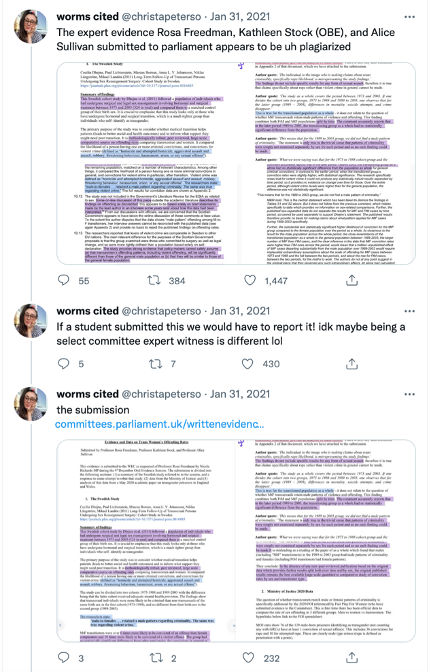
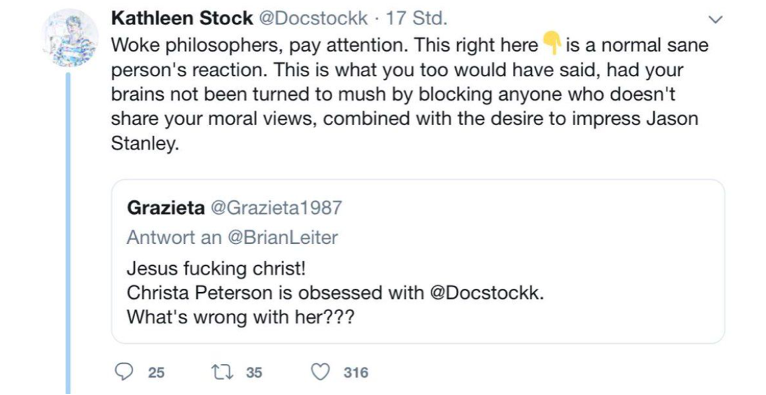
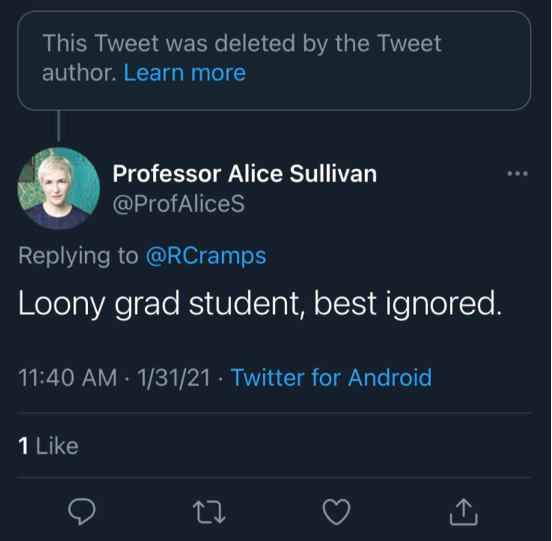
    This intervention from Prof. Alice Sullivan, for example, speaks volumes: Christa Peterson, a graduate student at USC, had observed that a submission to the UK government by three GC professors—herself, Prof. Stock, and Prof. Rosa Freedman—had been substantially quoted without attribution from a document authored by three different GC writers submitted to the Scottish Parliament. Reasonable people can disagree whether that attribution-without-citation eliminates the value of the UK submission, but it was beyond doubt that Peterson was correct to note that it violated both the letter and the spirit of the published guidelines for submitting written advice to a House of Commons Select Committee:

    I wanted to talk about this moment, because it seems to me that, relative to some of the more egregious examples of failure to teach that I’m going to discuss today, the stakes of this interaction are relatively minor. But “loony grad student, best ignored” captures the GC attitude towards students perfectly, combining as it does the indiscreet and unprofessional assessment of a student’s mental health, the contemptuous pulling of rank, and the casual confirmation that the best thing to do with students who challenge one’s work is to ignore them. I’m not trying to blame Prof. Sullivan for having created this state of affairs—that these words tumble so easily onto her Twitter is no mark against her, but rather a symptom of a profound institutional malaise. Where once, educators saw disagreeable and rigorous students as a privilege, we are now encouraged to see them as mere loonies, best ignored.

    While it will be necessary to talk about a couple more examples of students being misrepresented, threatened with legal action, intimidated, barred from reporting harassment, belittled, silenced, libeled in the British media, etc., this lecture is not going to litigate by example. Partly because although I think it is important to see exactly how our universities are being torn apart and by whom, I simply don’t think that most GC academics would contest the examples.

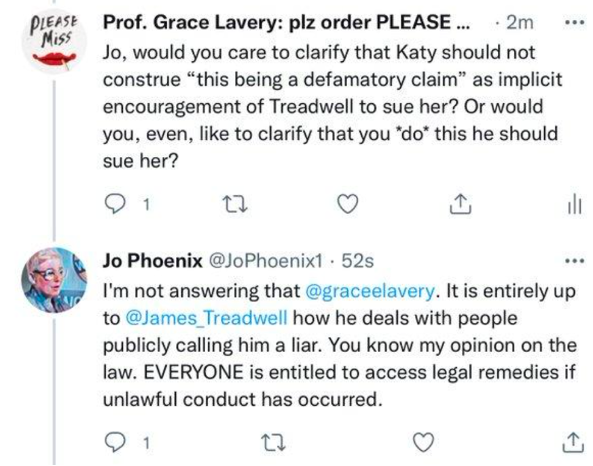
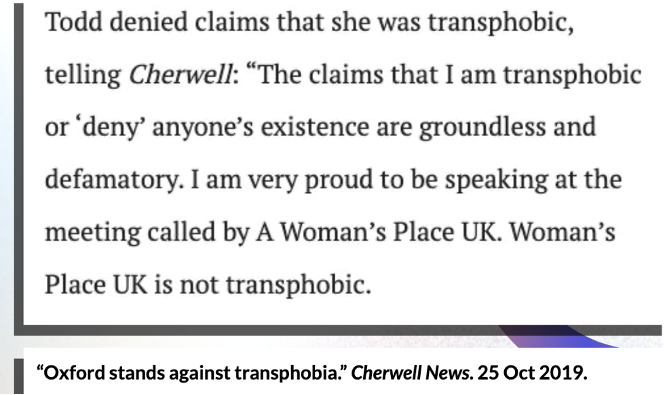
    Prof. Jo Phoenix, who has issued legal threats indiscriminately against students, colleagues, and institutions, has confirmed to me in public and in private that she does not think there is anything unusual or wrong with suing one’s students. Prof. Selina Todd at the University of Oxford has been reported to have issued legal threats against graduate students who have protested her lectures.* Merely pointing out that the GC movement sees students as obstacles to be silenced, either directly or by the abuse of legal instruments, would not, I think, move the needle: rather, I want to argue directly that these tactics are a mortal threat to academic freedom on our campuses. Hence the GC movement is not merely a threat to academic freedom, it is the greatest threat in a generation: not only have GC academics created a system whereby one teaches one’s students best when one teaches them at gunpoint, not only have they done so to the great delight of conservative politicians who despise the cultures of learning that have been sustained by the higher education sector, but they have done so while persuading liberal media outlets like the BBC and the Guardian that the students really do need to be put down for the good of the country. As a result, the previously far-right hatred of learning has migrated into our faculty lounges and needs to be confronted here, in spaces we once had the temerity to think safe.

    Before going any further, it will be helpful to define the two terms at the centre of today’s discussion, “academic freedom” and “gender critical movement.”

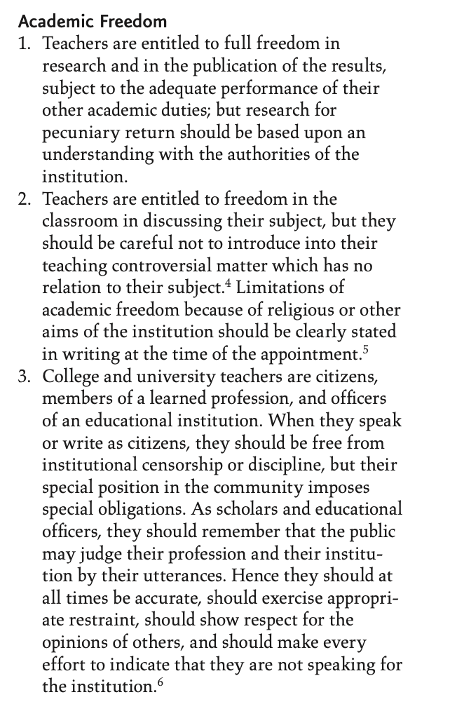
    The formulation of the principle of academic freedom was one of the twentieth century’s characteristically complex formulations of a universal right. Here is how it was formulated in the American Association of University Professors 1940 statement, which established the grounds on which the right to academic freedom tends to be asserted:

    So, an unlimited right to “unfettered” research and publication; a more limited right to say what one wants in a classroom; and a special responsibility to speak moderately when speaking extramurally. I’m in no position to lecture anyone about the third of those, I realize, since I’m about as immoderate an extramural speaker as anyone else, and in 1940 the AAUP didn’t have to contend with Twitter. But while clearly the 1940 statement’s definition of “controversial topics” requires refinement and clarification, it is worth nothing that the sensibility so often ascribed to millennial and Gen Z “snowflakes” was alive and well during the Second World War. The point at which the limitations on the right to classroom conduct became not merely defensible, but an indispensable dimension of academic freedom, was in respect of the controls on sexual harassment introduced into American academia by Title IX, the federal law which prohibited discrimination on the basis of sex in US education (parenthetically, Title IX therefore does not create a “sex-based right,” but rather prohibits the creation of such rights in educational settings). The AAUP has published a number of statements on changes to Title IX in the last decade, emphasizing the importance of academic freedom, but also emphasizing that the sexual harassment of students is, self-evidently, not a protected class of speech.

    And yet, no less self-evidently, academics accused of sexual harassment have most frequently turned to the discourse of academic freedom in order to justify their conduct. Consider the case of Rob Latham, whose tenure was revoked and who was fired from UC Riverside for sexual harassment in 2016. Latham had made the following statement to a student: “You’re an intellectual thoroughbred, kiddo, and I’ve mentored very few of those in my career. I have to resist the impulse to ride you too hard too soon. If you’ll forgive the equine metaphor.” In a statement to the UC Regents published on the AAUP blog, Latham’s defense of his position rested on the notion that these words were perfectly reasonable forms of encouragement to a student—that only homophobia could impute a lewd motive to them—and that they therefore fell solidly within the purview of academic freedom. Feminist critics of the situation, like Latham’s Riverside colleague Jennifer Doyle, disagreed, arguing that “[i]t is Latham, and the AAUP, who had forced us onto this forum by publishing this document. For his victims, this forum is on a continuum with the harassment that has characterized the experience of working and studying with him — just dragged out into the public sphere. We all want that harassment to stop.” Title IX is, of course, the relevant section of US federal law for assessing claims of misgendering or deadnaming students and workers, as clarified by Gorsuch for the majority in in Bostock vs. Clayton County, Georgia; whatever the AAUP’s conflict in the case of Latham and others, Joan Wallach Scott, the longtime chair of the AAUP committee on academic freedom, has assured members that on no grounds would academic freedom be a defense for misgendering.

    The GC position on academic freedom is rather different, and encapsulated in a 2019 essay published by Kathleen Stock in Quillette entitled “Stonewall’s LGBT Guidance Is Limiting the Free Speech of Gender Critical Academics.” Rather confusingly, the essay seems to use the term “academic freedom” interchangeably with “free speech,” when, as we have seen, they have historically borne not merely distinct, but in some sense conflictual, meanings. But for Stock, they are essentially identical: “Where teaching is explicitly informed by research, the dividing line between constraints upon teaching and constraints upon research is paper-thin.” Like Latham’s, Stock’s position is that Universities who impose restrictions on the classroom conduct of teachers who sexually harass students (i.e., who misgender them) are in violation of the principle of academic freedom. They are not, and the notion that one can maintain that position and refer to oneself as a “feminist” is itself evidence that the meaning of words is, in fact, observably plastic.

    In a passage I’ll flag now, but will return to at the end of the lecture, Stock also describes the consequences of her “gender critical” commitments:

    In my own case, I’ve experienced student complaints, FOI requests, campus protests, threats to milkshake me, the defacement of my office door, open letters to no-platform me, articles in the local press and student newspapers claiming I make the campus at my university “unsafe”, defamation by the Student Union Executive, an attempted smear campaign by academics at another institution, and various forms of student and public harassment. Occasionally, critics point to the fact that despite this I still manage to write and publish, suggesting that this gives the lie to any claim that I don’t have the freedom to do so. But I wonder how many gender-critical academics have been deterred from expressing their views by these tactics?

    To summarize: complaints, FOI requests, “the defacement of my office door,” open letters, articles, and “a smear campaign” are all, unpleasant as they doubtless are for the person receiving them (and believe me, I speak from grim experience), self-evidently forms of speech governed by academic freedom. Threats of assault (“to milkshake me”) are not. Yet Stock’s odd refusal to distinguish between vocal criticism from colleagues and students and criminal threats of violent assault indicates a troubling lack of familiarity with the very principles the author is claiming to defend. But more troubling still is the ease with which Stock dismisses the fact that she has, indeed, been free to research and publish however she sees fit. That is the guarantee that academic freedom supplies: that people publishing on hot button topics will always feel comfortable and affirmed in their opinions is not an entitlement, and absolutely should not be.

    “Gender critical movement” is, mercifully, rather easier to get to grips with: it refers to an active group of campaigners within and without the university, who defend what they call “sex-based rights,” oppose what they call “gender identity ideology,” and are skeptical of and hostile towards a group they call “trans rights activists” or “TRAs.” I’m not sure there’s too much doubt about who is and who is not a member of this group, but the term is nonetheless flecked with ironies, because it seems to suggest that some other group—perhaps trans people?—are insufficiently “critical” of something called “gender,” a notion that will surprise even those who have read no more than the title of Judith Butler’s most famous book. “Gender,” as Butler has argued consistently and persuasively, is a notoriously tricky concept to grasp, seeming as it does to draw together questions of syntactical class and aggregation, with socially-produced taxonomies of masculine and feminine; the relationship between these two usages is a difficult question that falls outside the purview of today’s talk, except to say that the matter is not in the least clarified by demanding, as some GCs have started to, that we refer to words like “her” and “his” as “sexed pronouns.”

    Ironic, too, is the fact that “gender critical,” laughable as it is as a designation of an intellectual position, displaced a term that was, at least in principle, defensible on its merits: trans-exclusionary radical feminism, or “terf.” That term, which is now only spoken on the BBC or in the Guardian in hushed tones and with the proviso that it is apparently “a slur,” identified a strand of radical feminism (not a ubiquitous radfem position, through probably at present the dominant one, at least in the UK) that wants to exclude trans women from the category of “woman,” and therefore to exclude actual trans women from women’s spaces. Yet because that position was easily identified among those that opposed it, those who were hailed as “terfs” demanded to be referred to by another name, and the demand was largely met. The broad censorship of the word “terf” is part of a worrying dimension of contemporary British culture in which the bearers of an idea being criticized are to be deferred to in respect of the language used to designate the position. My invitation onto Andrew Doyle’s GB News program was rescinded after I referred to Ann Coulter as a fascist, an observation that Andrew claimed revealed I was “not serious” about open discussion. But I am relentlessly serious about Ann Coulter’s fascism. One might also consider the fate of the term “eugenics,” the subject of a powerful recent apology authored by UCL workers: the term “eugenics,” inflected by histories of genocide, cannot be heard today except as negatively valued, yet it was not so for the figures who espoused those positions, and must not be abandoned as a term of historical analysis. Anyone who has not yet done so is encouraged to read the website “terf is a slur,” to see a number of anonymous Twitter accounts, many of whom seem to be teenagers, and most of which took place several years ago, saying cruel and obnoxious things about terfs. They might also wonder why “Tory” is not a slur, since it is so often followed by the word “scum.”

    Only one other brief comment on the term “gender critical movement” is necessary before advancing: the group often refers to itself as, simply, “women,” as in the hashtag Women Won’t Wheesht, or the writer J. K. Rowling’s claim that “women are organizing.” But this isn’t a good name for the movement, because the core advocacy group contains a number of men—Graham Linehan, Jesse Singal, Alan Sokal, Colin Wight, Colin Wright, Milo Yiannopoulos—all of whom are white—and because polls suggests that while, on the whole, UK men are receptive to GC talking points, UK women aren’t persuaded by them. These findings have been affirmed in a recent report by the Equalities and Human Rights Commission, even as the EHRC has been increasingly subject to GC capture in the last two years.

    I’m now going to work through a few examples. I want to stress before I do that, although I do think that individual GC academics are culpable for attempts to silence and intimidate students, I’m not trying to attack anyone personally. Most of the censurable conduct I’m about to describe came about because GC academics felt marginalized, and while I do not think that the feeling of marginalization derived from a fact of marginalization, it is hard not to sympathize with the feeling. I think these case studies might be usefully grouped together as unprofessional and unhelpful responses to a feeling of professional exclusion—however much harm has been done, I think it’s important to reflect that it doesn’t come from malice, but from misplaced fear. Fear of the young, fear of social media, fear of displacement, and yes, fear of trans women (the latter of which we might call an instance of “transphobia”).

    Adelaide Kramer—a student at the University of Wisconsin, Milwaukee—became the first target of the modern GC pile-on when the UK fascist provocateur Milo Yiannopoulos visited her campus in 2016. Yiannopoulos projected a photograph of her onto the back wall, encouraged the audience to mock her appearance, and delivered the punchline “the way you know he’s failing is I’d still bang him.” That line makes the connection between misgendering and sexual harassment punishingly clear, and it was on the grounds of the intimidation of Kramer that grad students at other US universities protested Yiannopoulos’s planned “tour,” because he had promised to do the same in his future events:

    If all it takes are a few strong words from me to make trans people leave women in peace in their bathrooms, I’m definitely going to up the ante. Really, if he can’t take a joke, how is he going to cope with having his dick cut off?

    In an essay I published in 2018 entitled “Grad School as Conversion Therapy,” I drew links between Yiannopoulos’s trolling and the emerging consensus among liberal academics that our students, and especially our trans students, were unable to face robust criticism. I suggested what I think is obvious, that the attack on Kramer was not a criticism but an instance of sexual harassment. But with the benefit of hindsight, two aspects of the Kramer case strike me as more prescient than I realized at the time: first, the strategy of mocking trans women’s appearance is widespread within GC circles (my own faculty profile picture was the subject of a bizarre controversy in 2019 led by the GC intellectual Jane Clare Jones), and second, the deployment of the phrase “having his dick cut off” as a punchline recalls a widely-shared video posted to YouTube earlier in 2016 by the GC YouTuber Magdalen Berns, in which she replies to the trans woman Alex Drummond’s stated anxiety about bottom surgery with the line “of course it terrifies you, Alex, they chop your cock off.” It’s not clear whether Yiannopoulos was adopting his line from Berns, but the similarity is enough to raise the possibility; more to the point, the fact that an identical rhetorical flourish was made by an alt-right Trumpist and a GC might occasion a little self-reflection among the feminists who have allowed the gender critical movement to overtake their organizations.

    But instead, the 2016 moment presaged a longer era in which speaking in insulting terms to and about trans women could be treated as a laudable kind of frankness. The most self-conscious GC essay I’ve read on this subject is a remarkable, lesser-known, piece of Stock’s entitled “When Bindels Speak,” published in 2018, and a defense of the GC feminist Julie Bindel. Stock quotes Germaine Greer making the same rhetorical move: “just because you lop off your penis and wear a dress doesn’t make you a fucking woman,” describing the line as “vividly Rabelaisian” and a similar passage as “refreshing, like a bucket of cold salt water has been chucked over me after days of humid air.” From an author who has written that the distinction between restricting publishing and controlling for sexual harassment is “paper thin,” this line of argumentation is troubling, and more than enough grounds for concern about the welfare of Stock’s trans students.

    Alex Wareham was an undergraduate student at the University of Reading when his own teacher, Prof. Rosa Freedman, published a private letter he had sent her asking her to explain her views on trans people in, of all places, the Daily Mail. The sentences that Freedman found offensive were: “I do not intend to get aggressive but rather ask for your opinion before I move forward as I would rather not ‘strawman’ you. I would recommend you choose your words carefully.” Ominous and a bit self-important perhaps, but solidly within the genre of awkward correspondence from teenagers that faculty have been receiving for decades and, I suspect, centuries, without having their names published in right-wing newspapers without their consent. A statement from the University of Reading made no reference to students’ reasonable expectation that correspondence with educators might remain confidential. The Daily Mail could barely contain its joy at having forced a professor to incriminate herself: the article refers to Prof. Freedman as “Miss Freedman.” Among the many gems in the comments, amidst threats to call the police on the grounds of Wareham’s “threat,” my favorite is this, from Sergeant Wilson:

    Our universities used to be hotbeds of dissent and debate, where all were welcome to speak and think. This is nothing short of the actions in Germany in the 1930’s, where no one spoke out against the rising tyranny.

    Wilson seems not to have noticed that the student in question is being penalized precisely for dissenting from his teacher, who reported him to the Daily Mail rather than bother to debate her position with him. (Nor does the Daily Mail reflect on the fact that, during the 1930s, the unspeakable truth that the paper championed was, of course, the position of the Nazi Party.)

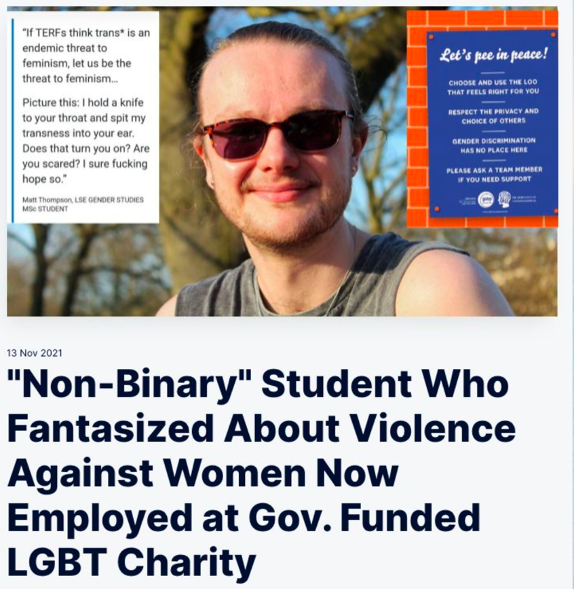
    An attempt to criminalize students’ work got rather further in the case of Matt Thompson, a trans masculine graduate student at the London School of Economics, who delivered a paper at a student conference entitled “Trans Endemics: Embodying Viral and Monstrous Threat in Times of Pandemic.” As the title suggests, the paper consisted of an imaginative attempt to perform the role of “viral and monstrous threat” ascribed to trans people in online spaces. Whether opportunistically or not, gender critical activists treated Thompson’s paper as though it were, literally, a threat, and led a Twitter campaign to criminalize them not merely for dissent but, in fact, “terrorism.” Thompson’s personal details, including place of work, were published online by GC websites as recently as November.

    And then lastly there is the case of Prof. Kathleen Stock herself, surely the most prolific and notorious of the GC censors. Since I have written on this topic before, and since Prof. Stock has a habit of describing her critics as “stalkers,” I’ll refer people to my essay “The UK Media Has Seriously Bungled the Kathleen Stock Case,” which is available on my website. But as a list:

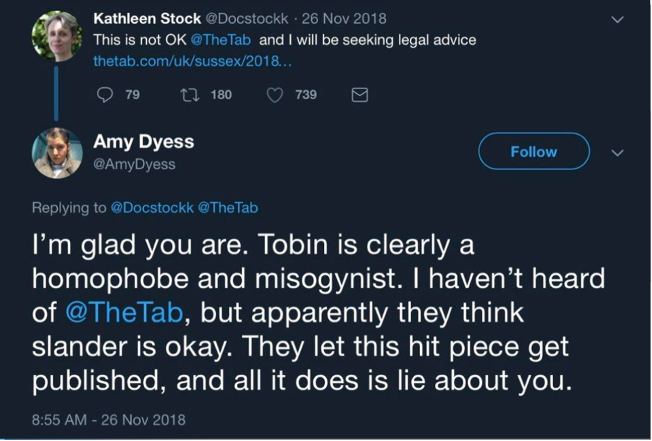
    Prof. Stock successfully prevented a student journalist named Katie Tobin from reporting that students felt “harmed” by her activism by threatening legal action against her and the paper; she later claimed not to know that Tobin was a student. Stock then led a Twitter pile-on of Tobin in which the nineteen-year-old was called a “homophobe” and a “misogynist,” in comments Prof. Stock liked. Tobin complained to Sussex about this, detailing the mental anguish that the pile-on had caused, in the process disclosing (as reporters of sexual harassment generally do) sensitive personal and medical information.

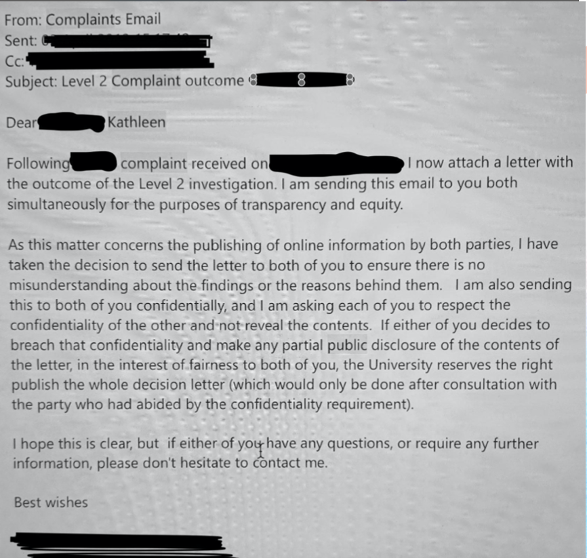
    The University not only found in favor of Prof. Stock, they effectively gagged Tobin by threatening to publish the report, medical details and all, if Tobin ever again discussed the matter in public. Since I initially reported on this issue, Prof. Stock responded that she too was bound by the same gag order—which is true, but irrelevant, since the report contained pages of sensitive information about Tobin, and mentioned Stock only in respect of matters of public record.

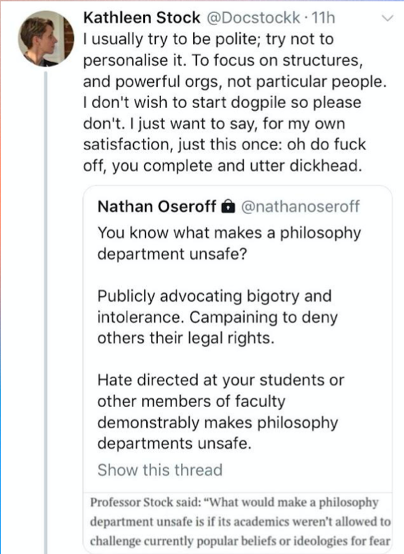
    Prof. Stock took issue with a substantial (not personal) criticism of her work made by a student philosopher named Nathan Oseroff-Spicer; Stock once again threatened legal action, publicly told the student to “fuck off you complete and utter dickhead,” and then pressured the blog where Oseroff-Spicer was employed to fire him.

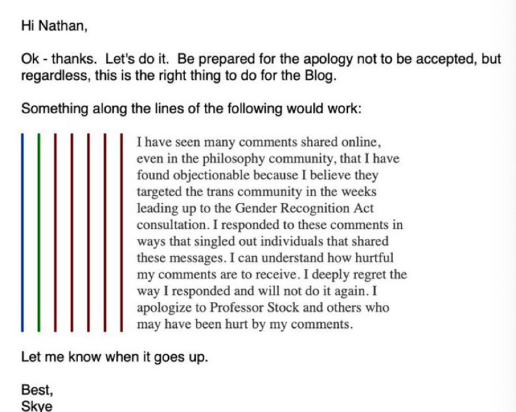
    The blog’s editor, Skye Cleary, sent Oseroff-Spicer a scripted apology that he would have to deliver (without revealing he hadn’t written it) as a condition of maintaining his employment. Oseroff-Spicer delivered the apology as requested, and was fired anyway. Skye Cleary hadn’t responded to my inquiry about the authorship of the apology, but the email she sent to Oseroff-Spicer reveals that the draft had been shared between multiple parties. Nathan Oseroff-Spicer has left academia.

    Christa Peterson, a grad student at USC, to whom Prof. Sullivan referred as a “loony,” has been subject to a barrage of personal abuse by Prof. Stock, much of which—including the accusation that she is a “stalker”—seems sexually charged.

    After Amelia Jones, a Sussex graduate student, accurately reported on the BBC that Stock had signed the “women’s declaration of sex-based rights,” a document that calls for the “elimination” of trans women as a class in law, Prof. Stock quite rightly demanded a right of reply, saying that she does not want to eliminate actual trans women, but then falsely characterized that reply as a “correction,” leading the [Daily Mail] to brand Jones a liar.

    At least one Sussex student, whom I’m not going to name here but whose name I’ve published elsewhere, was discouraged from filing a harassment complaint against Prof. Stock by Sussex administrative staff.

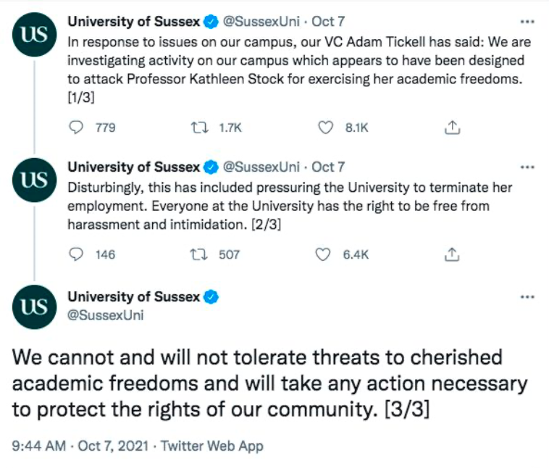
    When students and workers at Sussex protested their routine silencing by Prof. Stock and the Sussex admin, they published—a key word, if we think back to the AAUP’s demand for “unfettered” academic freedom—criticisms of Prof. Stock on posters and leaflets. The Sussex administration treated this act as though it were itself criminal, with Prof. Stock seeking police protection, and eventually resigning despite the Sussex Vice-Chancellor, Adam Tickell, issuing utterly unprecedented attacks on student protesters through official school organs.

    Any of these would be, I think, unprecedented. A broad movement, cheered on by scholars, to label students as terrorists and send them off to prison; the establishment of a litigious culture in which student dissent—including student reports of harassment—is treated by universities as actionable libel; attempts to shame students seeking debate in the right-wing press.

    So what do we do? I’m hoping you all can tell me. But I do have one thought, which I hope might be heard even by those who came here today to mock me. It is this: why don’t we try teaching our students? It is our responsibility, and not theirs, to ensure that the complexity of our ideas is communicated; our responsibility, not theirs, to create spaces in which errors can be corrected and dissent can be fostered. With this in mind, I’m going to end by reading out the ten principles of Academic Freedom for All, an organization that I started with comrades, colleagues, and students in response to the ongoing crisis in higher education.

    1. We believe that everyone has the right to research and publish without interference of any kind.
    2. We do not believe that assent is the goal of scholarly endeavor, and we value all modes of productive disagreement.
    3. We particularly affirm and champion the rights of students, independent scholars, contingent faculty, and all insecurely-employed researchers to research and publish work that challenges the orthodoxies of those with security of employment.
    4. We believe that the right to protest is a fundamental aspect of academic freedom.
    5. We condemn all uses of vexatious suits, baseless legal threats, and all forms of intimidation designed to suppress scholarly exchange.
    6. We call for legal and institutional protections for insecurely-employed scholars against such threats.
    7. We believe that an inclusive and diverse working environment is a prerequisite of academic freedom, not a threat to it.
    8. We affirm that securely employed scholars owe a duty of care to their students, which should prevent them from (for example) engaging in retaliatory conduct designed to silence them.
    9. We demand adequate financial and institutional research support for all college and university workers who seek it.
    10. Academic freedom is a general condition, not an individual entitlement: unless all workers are free to research and publish, that condition does not exist.

    And if anybody present would like to sign up to these principles, you can add your signature through the AFA website.


    * Addendum: I included this allegation regarding Prof. Todd in error, having wrongly believed a piece of evidence that I’d seen to be publicly available. I am therefore happy to add that I do not have the evidence to prove this claim, and would have retracted it if invited to do so, either by editorial or legal staff at UCL. I do not concede that it is either libelous or false.

    ∿

  • Fighting TERFs, Vomiting, and Writing Bathos

    w/ Daniel Lavery ∿ Bitch Media ∿ February 22, 2022

  • Please Miss: In Conversation with Elif Batuman

    Greenlight Bookstore ∿ February 9, 2022

  • Making Grad School Work for Weirdos

    The Chronicle of Higher Education ∿ Feb 3, 2022

  • Belatedly, I’m Leaving Substack

    A little less than a year ago, I accepted a Substack Pro deal for a significant amount of money to publish on this platform for a year. Today, I’m walking away from that contract and shutting down my account. I’ve exported the email addresses of everyone who has subscribed and will add everyone, for free, to whatever platform I decide to publish with next. I might also take a break from the newsletter hustle. I’m not sure, I’ll see how a couple of other things shake out. I’m proud of a lot of the writing I’ve put on this site, though, so while I’m going to be deleting everything from Substack, I’ve already uploaded everything from the last year to my own website.

    I’ve never been under any illusions about why a literary scholar specializing in Victorian literature and psychoanalysis was offered a lot of money by a tech start-up. (A lot for me; obviously, pennies for them.) It’s because I’m a trans woman, and about a year ago, Substack was facing public criticism for its publication of a number of authors critical of the movement for trans civil rights. As it happened, I thought that the criticism often blurred an important difference: between libelous and hateful attacks on individuals on the one hand, and criticism of trans civil rights claims as a matter of public policy on the other. I thought, in other words, that it was important to acknowledge that, while I disagree with Jesse Singal’s work very profoundly, I don’t think it is strictly hateful; Graham Linehan’s activism, on the other hand, is very clearly motivated primarily and consistently by a lurid hatred of trans women, particularly those who love and have sex with other women.

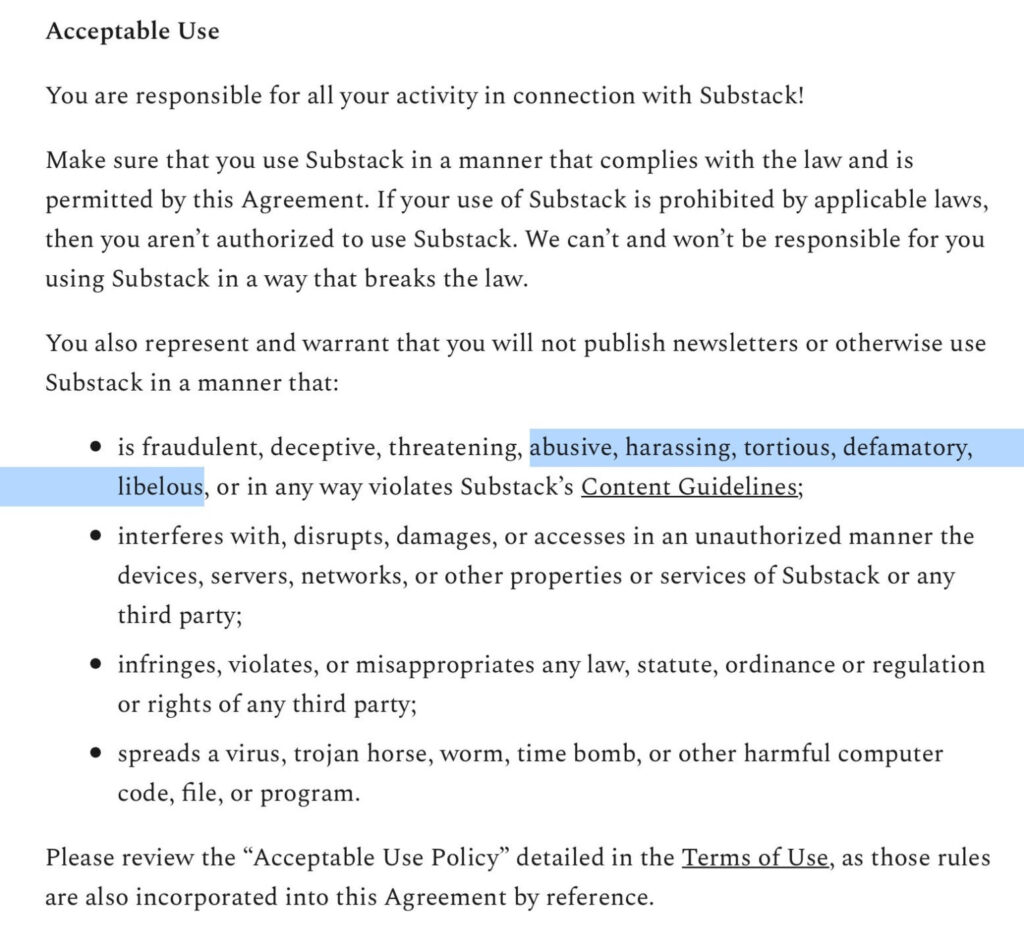
    I still think this distinction matters, and that it is captured fairly well by the Terms of Use that Substack publishes.

    Substack Terms of Use regarding Linehan's hatred of trans women

    But I no longer have any faith that the executive team at Substack will enforce these Terms of Use, or the Content Guidelines.

    So because I do not trust that the platform will enforce its own rules, I’m leaving.

    However the term has been degraded by present use, I’m a passionate believer in free speech. In my view, trans people have a particularly intimate need for language as a vehicle for freedom: we, perhaps more than anyone else, are people whose fundamental sense of ourselves has depended on our ability to describe ourselves freely, even at profound personal cost. As a scholar and editor of scholars, I recognize the necessity of disagreement, plurality of opinion, and dissent. And someone who has been wrong many times, about many things, I’m particularly grateful to colleagues and interlocutors who have corrected me, sharpened my thinking, and jostled me closer to the truth, even when those jostles have also felt painful. I’ve taught classes at UC Berkeley defending free speech, worked closely with students whose political commitments profoundly contradicted my own, published essays on this subject many times, including on this newsletter. I have defended free speech in conversation with my own comrades, and I have helped to found an organization committed to Academic Freedom for All, a position I am planning to defend in a live debate with anti-trans campaigners in the UK. I care about freedom, and language, and the relationship between the two, more than anything else.

    So it makes me worse than miserable—it makes me feel positively nauseated—to read shady corporate garbage like this pouring forth from those who’ve helped to pay my bills:

    [A]s we face growing pressure to censor content published on Substack that to some seems dubious or objectionable, our answer remains the same: we make decisions based on principles not PR, we will defend free expression, and we will stick to our hands-off approach to content moderation. While we have content guidelines that allow us to protect the platform at the extremes, we will always view censorship as a last resort, because we believe open discourse is better for writers and better for society. 

    Either deliberately or otherwise, this last sentence conspicuously equates the enforcement of “content guidelines” with censorship. That is, Hamish Mackenzie, Chris Best, and Jairaj, who signed the letter, believe that their own injunctions against abuse and harassment would, if enforced, amount to censorship. I can’t continue to work with people who think that’s true—especially when I’ve personally explained to them, more than once, what’s wrong with it.

    It’s important to understand why this isn’t true. People often think about this kind of online “abuse” only from the perspective of the abuser—someone who says cruel things, but who should be allowed to run his mouth off anyway because of his right to free speech. That’s fair enough at the scale of the individual. But it doesn’t work at the scale of the system. If abuse of a minority is allowed to continue unchecked, members of that minority will be excluded the system. Historically, this is why jurisdictions place controls on defamation and libel: to ensure equitable access to the public sphere.

    But national jurisdictions are clearly incapable of performing that role in this case. For example, I’ve been advised by a number of lawyers that Linehan has libeled me, and that any court in the UK or the US would evaluate our dispute in my favor. The problem is that he lives in the UK, and I live in the US, so neither jurisdiction would hear the case. Our contention, such as it is, exists online, rather than in a national space—and so it is important that online regulators decide how they will ensure the same equity of access to the public sphere that the liberal rights-based framework of “free speech” had attempted, often very unsuccessfully, to supply.

    What Substack has done instead is to deny any responsibility of this kind. The first time I told them that something Linehan had published about me was libelous, they responded by telling me that, of course, if I could convince a court of that, they would follow the court’s lead. I found that pathetically evasive at the time, and said so. But after a full year of grotesque personal libels, each more flagrantly in breach of the Terms of Use than the last, I now think it’s something more sinister than that. Substack acts like a corporation—and so it should, it is a corporation, and very clearly the commercial interest is in monetizing the angry centrists like Singal, Glenn Greenwald, and Bari Weiss. But it has decided to talk like a state, and present itself as the guarantor of rights that its corporate conduct, in fact, is fast eroding.

    That’s why my decision to leave the company was made halfway through my trawl through this truly repulsive trail of managerial slime:

    It is, of course, massively important to the angry centrists that their egos are flattered, and so they must be told again and again that they are the underdogs. But there is absolutely no need for the platform itself to keep up this pretense—except that it has decided to adorn its shabby commercial interest with gaudy moral nostrums. If the company itself has swallowed the notion that controlling for abuse and harassment is a form of “censorship,” then public regulation of these platforms has become a logical necessity. There’s a case for public ownership, in fact—because Substack are publicly deferring to legal domains that, in fact, do not bind them.

    The argument, however, is not persuasive. Yesterday, Greenwald published one of his usual link-thick clause-bombardments, this time directed against Neil Young on the one hand, and the critics of his own platform on the other.. His argument concerning the nature of censorship eventually led him into this peroration:

    None of this is to suggest that American liberals are the only political faction that succumbs to the strong temptations of censorships. Liberals often point to the growing fights over public school curricula and particularly the conservative campaign to exclude so-called Critical Race Theory from the public schools as proof that the American Right is also a pro-censorship faction. That is a poor example. Censorship is about what adults can hear, not what children are taught in public schools. Liberals crusaded for decades to have creationism banned from the public schools and largely succeeded, yet few would suggest this was an act of censorship. For the reason I just gave, I certainly would define it that way. Fights over what children should and should not be taught can have a censorship dimension but usually do not, precisely because limits and prohibitions in school curricula are inevitable.

    Only one link here, to an article declaring victory against creationism, albeit one published in 1987, before the issue has even become a flashpoint in the culture wars. But Greenwald’s sloppiness with sources isn’t the problem—and he isn’t usually that sloppy, either. The problem is that his argument is completely impossible to follow. It seems to be something like:

    1. Some would say that legislative efforts to ban critical race theory are censorious.
    2. “That is a poor example.”
    3. “Censorship is about what adults can hear, not what children are taught in public schools.” (One might have wished for a link to clarify that rather theatrical claim.)
    4. Liberals successfully suppressed creationism, “yet few would suggest that was an act of censorship.”
    5. But I, Glenn Greenwald, would define it that way.
    6. Debates about what children should be taught are kinda-censorious, kinda-not.

    It is difficult to escape from this paragraph without the strong sense that Greenwald sees “censorship” merely as that which “liberals” advocate—whether that is critical race theory or evolutionary theory—and that whatever “liberals” don’t like, is actually “free speech.” But to deploy a somewhat Greenwaldian rhetorical construction, the incoherence of his word salad is useful, in so far as it is instructive. This man doesn’t know what “censorship” is, and has simply aligned his political interests completely with those of his corporate employer.

    I don’t advocate anyone else leaving the platform—the point remains, make that bread if you can. I’ve discussed this briefly with Danny, but not in great detail, and I don’t expect him to make the same decision. I hope this situation improves. Hamish could improve it, at a stroke, by committing to transparency in respect of complaints. Or Hamish could confirm, as I suspect, that no Substack account has ever been censured on the basis of a violation of the terms of use or content guidelines. Hamish, of course, will do neither of these things, because his strong corporate interest is to act like a corporation (secretively and exploitatively) and talk like a state (grandiose declaration of liberal values). I think that’s sad, as well as objectionable.

    But for me, free speech is too important to leave to this sleazy group of millionaires. The stench here got too strong, and I’m leaving. Thanks to everyone who has supported this work––I will see you all around and about. My Twitter handle is @graceelavery; my Instagram handle is @grace.lavery.pangolin. See you all around, friends.

    ∿

  • Please, Prof. Stock, Sue Me for Defamation, So We Can Finally Figure Out What Your Point Was

    I’m republishing here a short article entitled “Sussex Uni decide not to take action against Kathleen Stock over trans comments,” which was written by a then-student journalist named Katie Tobin, and initially published by a student newspaper called The Tab in November 2018.

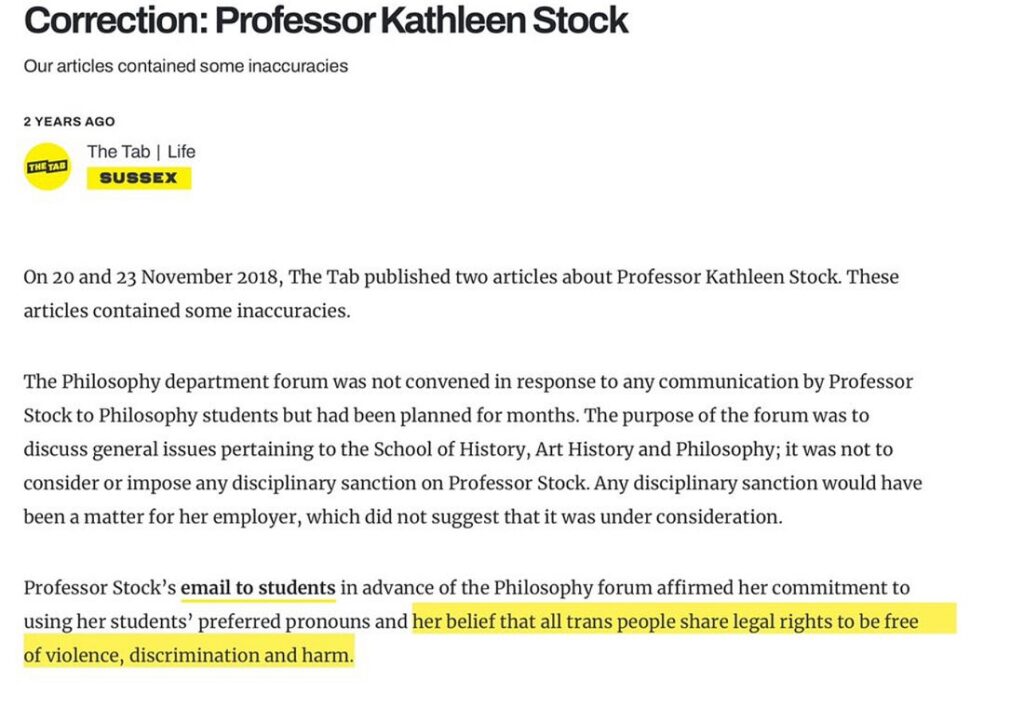
    It was, however, quickly withdrawn from circulation after a set of legal threats issued by Prof. Stock, who claimed that the article had defamed her. Seemingly intimidated by being the object of a legal threat, The Tab withdrew the article and published this correction:

    It is not normal for faculty to threaten to sue student newspapers. I cannot think of another occasion on which this has happened. And yet it is part of a pattern on which I have reported before, in which UK-based gender critical activists launch meritless lawsuits at students and activists who lack the financial means to defend themselves in court, and are forced to fold. Their having done so is then treated as a “win,” and the UK media duly report that some gender critical feminist has won a famous battle against online bullies. The truth, as we can see, is the exact opposite: institutionally secure academics using their money and power to silence their critics.

    You will notice that the alleged defamations are (1) that a meeting of the Philosophy department at Sussex was convened to discuss general issues, not Prof. Stock’s conduct specifically, and (2) that Prof. Stock believes that trans people should not be the subject of discrimination.

    In respect of the first alleged defamation, Katie’s article below did not claim that the forum was convened to venture Prof. Stock, merely that “the department of philosophy is listening to students, and is welcoming students to voice their concerns.” Does Prof. Stock think that this is defamatory?

    In respect of the second alleged defamation, Prof. Stock’s claim that she does not believe trans women should be the subject of discrimination is, at the very least, ambiguous. Prof. Stock believes that trans women should be sent to male prisons, use men’s restrooms, participate in men’s sporting events. It is like saying that a ban on gay marriage isn’t discriminatory, because gay men enjoy the same right to get straight-married as anyone else.

    In other words, these defamation claims are scandalously weak, and The Tab should not have withdrawn the article.

    I believe that Prof. Stock simply wished to use her institutional clout to silence a critic—a tactic that she, and the broader “gender critical” movement, have deployed time and again. The critic was, at that time, a nineteen year old first-year student at Sussex University, at whom Prof. Stock directed her hateful Twitter followers. To defend herself against the charge that she had treated a student poorly, Prof. Stock claimed to an internal review board that she didn’t know that Katie was, indeed, a student. I don’t believe that that was true: The Tab was a student newspaper, and the article in question concerned student welfare.

    I’m also curious as to which legal firm advised Prof. Stock of the credibility of her defamation claims against The Tab. Perhaps it was an unscrupulous company looking to steal a few quid from a student newspaper. Perhaps there was no law firm, and Prof. Stock wrote the letter of intent to sue without, in fact, having sought legal advice or representation. Most troublingly of all, perhaps the letter came from University of Sussex counsel, since we know that Vice-Chancellor Adam Tickell had cut corners and changed policies to protect his Twitter celebrity philosopher.

    These issues matter, because to this day the institutional corruption at Sussex University, and throughout the gender critical movement, has yet to receive any serious attention in the UK media.

    So, I’m trying something new. With Katie’s permission, I’m reprinting her initial article from 2018. If it was defamatory then, it is defamatory now, and I will be receiving a letter from Prof. Stock or her representatives detailing the case for defamation. The absence of such a letter might be taken as an admission that the original claim against Katie was without merit. But worse, it would confirm something we already have grounds to believe: that Prof. Stock would never send such a letter to a person like me, since I have the means to defend myself against the frivolous and censorious lawsuits she uses to frighten her own students. It would confirm that gender critical activists like Prof. Stock have no interest in open debate and discussion, and only wish to leverage every degree of possible influence to shut up those who disagree with them.


    Sussex Uni decide not to take action against Kathleen Stock over trans comments

    by Katie Tobin

    Katie Tobin, student journalist

    Following recent events at Sussex, the once welcoming, diverse, and accepting reputation towards the LGBTQ+ community that was once held by the university has been put into question.

    National coverage of Kathleen Stock’s interview with the Argus this summer stating “trans women are still males with male genitalia” and her recent email to every student in the philosophy department have created a hostile and unwelcoming atmosphere within the university towards trans students.

    Trans students are an already marginalised group. However, members of staff, who are in a duty of care towards students, openly writing articles such as “why self-identification should not legally make you a woman” have proved extremely detrimental towards the welfare of trans students at Sussex. This appears to be all in the name of philosophical debate and academic freedom.

    One student at Brighton said: “I came to Sussex hoping that’s it inclusive because it’s in Brighton. I identify as male and I don’t want to go to a university that supports this person… I’ve chosen Brighton University over Sussex for further study because of this.”

    The conclusion of the recent HAHP forum was that ultimately, as an institution, the university cannot currently take action against Kathleen due to the academic nature of her writing and the disassociation with her own beliefs with those of the university.

    However, the department of philosophy is listening to students, and is welcoming students to voice their concerns.

    The Sussex Centre for Gender Studies released a statement earlier this week to show solidarity with trans students, stating: “On Transgender Day of Remembrance, we are also reflecting with sadness on the hostile atmosphere being fostered by current ‘debates’ around the rights of transgender people.

    “These have constructed trans people as aggressors and predators, erasing the fact that they are one of the most vulnerable groups in our society.

    “Such transphobic ideas in public discourse create a climate in which trans people are more likely to feel unsafe, and can also embolden others to act out their prejudices in a more open way.”

    Reaching out for help is hard, especially if you don’t know where to turn to – so we have compiled a list of support services available to trans, non-binary, and gender non-conforming students if you are in need.

    Allsorts Youth Project

    The Allsorts Youth Project provides a safe space for members of the LGBTQ+ community for a fortnightly meeting. “Young people are able to meet in a comfortable & confidential setting, access one to one support with youth support workers, access information and participate in workshops and activities.”

    Brighton & Hove Switchboard

    The Brighton & Hove LGBT Switchboard is a charity that was set up in 1975. Formerly a just helpline, Switchboard now offers a place for “LGBTQ people looking for community, support or information.”

    They connect people and support them directly through specially developed Switchboard services or link them to other specialist organisations.

    The Student Life Centre

    The Student Life Centre can provide students with a directory to helpful resources all over campus; including counselling and more.

    MindOut

    MindOut is a charity that focuses on the mental health of members of the LGBTQ+ community. Last year they helped 1,342 people struggling with social isolation, suicidal distress, financial hardship, discrimination and prejudice, hate crime and exclusion.

    Clinic T

    Clinic T offers a sexual health service for anyone who identifies as trans, non-binary or gender variant (partners are welcome too).

    The clinic runs every month and upcoming dates are posted above. All of their services are free and completely confidential, and their staff have been trained in trans awareness.

    Remember, you’re never alone and there is always someone who can help if you’re struggling.

    ∿

  • coda: the duke of edinburgh

    Another conference. And I am saying, no, it’s not a thesis,

    it’s a proposition. The term “thesis” blurs an important distinction

    between theme and claim, deriving as it does from music,

    specifically from the toccata, and the recursion pattern.

    Like in “Carol of the Bells,” there is a thesis, and it is prosecuted

    (slide into carceral metaphor-family already preempted, no doubt)

    and the effect of the carol depends upon the proof.

    If you don’t like it, you’re probably not persuaded.

    And we say that too—“I’m not convinced by that”—

    or, conversely, that we are convinced, and that the conviction (n.b.)

    has been adequately conveyed. But clearly this isn’t the same

    as an argument, which needs something more than narrative,

    something more than satisfaction and fit, even if,

    as is probably the case more often than we like to admit,

    the forms of necessity that govern reasoning are still subject

    to the same essentially preferential responses as narrative.

    When we’re watching Eastenders, my husband says

    “they won’t do this, they won’t make it happen again,”

    and of course they would and might even. And my mother,

    who is here for Christmas, just hides and clenches

    and says that she needs to smoke a cigarette.

    Only my response is correct and for that reason

    I am not going to repeat it here.

    So anyway, I was telling you all this in a dressing room,

    where we were hanging out with your other advisor,

    the one you like more than you like me (he’s my friend tho)

    and you got it at once and the other guy knew things I didn’t

    and it all got very “classical gas” if you know what I mean.

    Sometimes I feel like a homosexual and like all this

    could have been avoided. I can’t remember what you

    had written about but it was green and small

    and there were many of them of irregular but uniform shape.

    It was space age: dressing room, topic, perhaps even conveyance.

    And then a short time later I’m seeing a play,

    and it’s that older woman, bad mama, the one who scares me,

    the one whose life must not be in my future. My friend said

    “the clique will kill you” and god knows i know but otoh

    what else is there but the socialization of language!

    And she’s doing an old Attention Scum routine in an art gallery,

    maybe switching into and out of Alan Parker, Urban Warrior,

    and I feel expropriated, which is gutless and stupid of me,

    and anyway she’s a colonial just like me. I’m a wanker,

    but we’ve heard it before, or I have (don’t know about them)

    and it sounds more like Martin Luther’s pecker than it used to.

    I’m in a wheelchair because why not.

    Okay and it’s now “the problem with London is it’s TOO BIG”

    and of course I realize that the point is that my mother,

    who grew up in London, or sort of did, is here in New York,

    and all her great fault is a refusal to cede the center of the stage.

    Whenever we mention a place in New York, she replies,

    treading on our toes, “yes I’ve heard of that,”

    ticking off the checklist of cosmopolitan technique

    like a fetishist. And it’s hard to listen but also hard to bear a grudge.

    And my girlfriend seems to be pulling away.

    I mean clearly the reason I am so obsessed with dreams

    is because from a certain perspective life depends

    upon one’s willingness to treat material reality as a symptom

    of a more fundamental truth available only to psychic introspection.

    I don’t know why she needs to do Attention Scum in a gallery,

    but she does look a bit like Simon Munnery, who was nice

    to me when I met him in Edinburgh to ask his advice

    about how to be an artist and writer. I forget

    what he said. She bolts and leaves me in charge,

    so now I’m doing Attention Scum in a gallery and god knows

    I’m lazier than she is, than almost anyone I know really,

    and would be even more so if I still took a lot of drugs.

    Which I think about from time to time. Were they so bad?

    Another sober transsexual tells me she is scared

    of being a drunk woman and I know what she means.

    I waste everyone’s time with a wheelchair pratfall.

    I’m walking away and there’s now an unctuous older gent,

    and it’s NOT Edward Fox, because he’s here all the time,

    I may as well call him THE INESCAPABLE EDWARD FOX

    and Lawrence Fox blocked me on Twitter and I never

    even said anything about him and isn’t that hilarious?

    (That last part is one hundred percent true.)

    Anyway it wasn’t Edward Fox but some guy who made a career

    doing one role, and that role was Philip Mountbatten,

    the longest serving “royal consort” in history

    although one can’t quite imagine him eating her out.

    Maybe that’s naive, but my grandmother’s friend

    knew him in the Services, during the War, and such a lout

    you never knew. Pouring beer into the piano and scaring the girls.

    Which may well have meant raping them but far be it from me.

    The actor who played him always retained a distance,

    and the physical resemblance was not entirely his fault,

    though clearly he had done little to change it,

    lucrative as the position had become. And we were old friends,

    somehow, and he said there was only one question

    that interested people, and that was how he felt when

    Philip Mountbatten died. His answer suffered from being

    over-theoretic; it was hard to deduce, as though composed

    in a meta-language that only he could understand.

    I sometimes think this about the feelings of aristocrats,

    though this man may not have been one, though he was one

    by virtue of being a famous actor, albeit an actor

    famous only for playing a single role. There was a story

    that was doing the rounds about a guy who was into toy crocodiles

    which, I don’t know if he means simulacra of crocodiles

    or if it’s a class of crocodile much like “toy dog” could be said to be.

    Dude was aware of the story, that’s all he was saying,

    and then he said he was at the agential draw

    (agents pick clients in a draw: actors line up and each agent picks one

    at a time, until all the actors are gone, just like sports)

    and you have to have strategies reflecting not just absolute value,

    but value of a given commodity relative to their

    position in the draw.

    Nobody outside of the corporate world understands game theory

    which is how they all get along so well. Except my one friend.

    The actor told me he wanted me to have been at the draw

    and he said as much but then I had to remind him

    that I’ve got nothing to offer and can’t even play

    Attention Scum very well.

    The crocodile guy. Everyone loves him. Now he is

    a silver ball, traveling on its own steam down the spacey corridor

    and he says “My name is Michel Utrecht, and I am

    a graduate student at the University of Utrecht,

    where I am writing a dissertation on Marxism-Leninism

    and contemporary European fiction.” And I guess that checks out

    maybe. And a stylish guy leans over to me and says

    “I don’t think this will work out well for anyone except Substack,”

    and I realize it’s weird that I’m part of this stupid story also,

    and the silver ball travels through the air towards a laptop,

    and he pauses before the laptop, to tell us that he

    believes that Marxism-Leninist doxology continues to shape

    the narrative form of the contemporary novel,

    and he recites a little bit for us. It’s clear he has a fondness

    for Marx but also feels detached and maybe a bit bored

    at what the other people think of Marx. Everyone

    has a Marx and they’re all fucking awful, except mine.

    (Preach.) I’ve read this crocodile enthusiast’s Marx

    and he makes the same mistakes everyone does:

    he thinks Marx is an anti-capitalist; he thinks Marx is a socialist

    etc etc. Not even the interesting wrong Marx, which is

    the one with the competing theories of political

    organization,

    although (politics voice) of course politics didn’t interest Marx

    very much. Then the silver ball merges with the screen

    of the laptop and slowly begins to include itself, and now

    it is merging into the screen. And I say to the actor

    “this is what they call telepresence robotry,” and he winces,

    because surely that can’t be right, and now

    the voice of Michel Utrecht is coming out of the laptop

    and it says “you’ll pardon my display of telepresence robotics,

    but in my view remote delivery will transform the way

    we share ideas and organize both our scholarly and political collectivities.”

    Oh god oh god oh god oh god,

    and really I’m just wondering whether there is a relationship

    between computers and Leninism. I think Lenin

    might very well have enjoyed the internet, although

    I am far from sure that this should change anyone’s view of either.

    Maybe I should have been at the draft pick.

    I stand on the table and wonder why I did that.

    ∿

  • how i came to buy a new coat

    “If romanticism’s so bad, why are you always howling?,”

    I asked the well-dressed assistant director at the mic.

    She looked back agog, then changed into a silver fox.

    Typical. I didn’t even know how I got on this ship,

    or why Princeton University was now seaborne,

    or why I had brought my mother along. My mother,

    incidentally, had heard me give one talk before,

    on the history of the haiku, at an almost diplomatic

    scholarly event. Scholars as dignitaries, and my mum

    wanted to be introduced, as one would a VIP.

    But I was barely a P, let alone VI. Anyway,

    she complained, obviously, and told me

    ——that she was ashamed of me

    ——that I was a foolish little boy

    ——that I wasn’t fooling anyone

    ——that I was a maelstrom of snot and fidget

    (she was right about that, let’s face it)

    ——that nobody could even understand what I was saying.

    Here I am, some years later and a grown transsexual,

    and complaining about my mum being mean to me.

    We didn’t speak for several years after that. I nearly died

    of alcoholism. Anyway it’s Christmas and she’s flying here.

    So I’m on a boat and it’s Princeton and my mother is here,

    as is that oikish boy who I went to school with,

    my erstwhile chum, who—wait, what did he do

    with himself? I never thought he’d come to much,

    and if I recall correctly it was a tech start-up or a minor quango.

    But here, shit, I have to hand it to him: the boy learned to sing.

    Robust baritone, and it’s popping out of his precisely calibrated

    weskit, and he holds his hand like a singer does.

    What’s he singing? I can’t hear, is it “Some Enchanted Evening”?

    He’s got a following, the pot-bellied mediocrity made good,

    and there’s a whole frog chorus croaking it out with him,

    but I can’t hear what it is, it’s just a swirl-a-whirl.

    Leaning on the boat, and the group are swaying like an iceberg,

    like koalas left on the tundra, drunk on climate,

    and the tops of their heads merge with their eyes,

    next it’s eye-heads, now bulging out of necks. Swaying,

    and it’s big eyes, pupil-balloons, mouth-lids on the bottom.

    Silver fox takes the stage: “let’s have a big hand,

    for our special guest P——— J———, who’s come

    all the way from Birmingham, England, to be with us tonight,

    and who has taught us all a thing or two about using

    lawn ornaments and furniture in the most eco-friendly ways.”

    GARDEN CHAIRS, fuck: do I remember smoking weed in a hammock,

    with him, or maybe his weird effeminate friend I disliked?

    Or one of his many cousins, who fancied themselves cooler than us?

    It’s pathetic, really, trying to make oneself the origin of a prince of frogs,

    we haven’t spoken in decades, and there’s no way

    he would possibly have any sense I was speaking today.

    My mother always hated him. Well, but she’s a creature of hate.

    He had come to see me in San Francisco when I lived there.

    He was impressed at how much I drank and my cocaine hook-up.

    I think we even talked about lawn furniture, even. Burritos,

    al pastor, the kind with pineapple, at one of the shonkier

    Mission cafeterias. Who that was born to Albion abhors a palm tree?

    They had one at the Kingfisher Centre in Redditch

    and everyone said it was very good. Italian mosaic,

    google “Italian mosaic muralist” and of course you get Veronese.

    Paolo something. Anyway the burritos were good,

    and I kept it together, didn’t piss myself or owt.

    Silver fox continues: “our next guest is a professor of English,”

    audible consternation, “who is here to talk about the genius

    of Stephen Sondheim.” I wasn’t. And even if I had been,

    I wouldn’t have phrased it like that. Still she went on,

    “Who died earlier this year.” That, he had. I was in an art gallery,

    with my lover Lily, when I heard. It was hard for me

    because the art was fun and contemporary, and the

    staff seemed cool. And I was like, lord save me,

    from being one of those lugubrious faggots

    who seem more able to whine about the death of a songwriter,

    than celebrate the force and color of a thousand mosaic pieces,

    and anyway his best work was a half-century past.

    Except, no, I don’t believe that. I know I’m supposed to think

    Gypsy the high watermark, and Company the end of it all,

    but the truth is, I like the trash. Well, within reason,

    not Sweeney, I mean it’s fine, but Night Music is my favorite,

    and if I had wanted a name, when it came time to get one,

    I should probably have selected “Desirée.” But that’s too camp,

    and I have been flirting with this other transsexual recently,

    and I asked her if she preferred Loretta Lynn or Dolly Parton,

    and she said “both too camp for my taste,” and I thought,

    well, I daresay David would approve, but how can I

    respond to that, in my silver jodhpurs and Liberace wig?

    I sometimes think people don’t even notice I’m there,

    which even sounds like a line from A Little Night Music,

    and honestly it wouldn’t be any worse even if it were.

    The Liberace thing is odd. Early on in my recovery,

    when I was going to meetings every hour of day and night,

    there was a homeless Black man named James we all knew,

    he hadn’t been sober since leaving Vietnam, but he always

    said he would take us all to Las Vegas if he ever made it.

    He died in a fire, a block or two from the Ghost Ship,

    after falling asleep with a lit cigarette in his mouth.

    One night, we caught each other’s eyes on the tarmac,

    and I was made up and twinkled, you know, like a

    whatever-the-word-is, you know, nancy, and he asked,

    “you know who you remind me of?” and i said no,

    and he said “Liberace,” and I said, “oh?” but he didn’t hear,

    went on, “and that motherfucker was—” theatrical pause—

    “the greatest motherfucking pianist in the universe.”

    And I knew he was right. AND that’s how I know Michael Douglas

    is a homosexual. That and an incredible story I heard,

    third hand, from a professional LA cocksucker,

    who told my friend he fucked Michael Douglas,

    drove away, but then was recalled to the hotel,

    only to be confronted and then, subsequently, fucked

    by Spartacus himself, Daddy Douglas, while Michael peeked.

    God knows if it’s true but my friend said the hustler was trustworthy,

    and isn’t there something in it that just feels true? Is to me.

    I say to the silver fox, “I actually don’t have anything

    on Sondheim, right now, unless you’d like me to extemporize?,”

    and he said that sounded good, he wasn’t listening,

    and anyway the crowd was dispersing, nobody cared.

    I can’t even remember what I did talk about, and my mother

    wasn’t impressed, any more than she had been the first time,

    but at least she held her tongue. When Sondheim died,

    I wanted to buy a big black coat I had just found,

    and it was luxe and expensive, and I thought it would

    make me a real woman. And I still think that, tbh.

    I wanted to go to Marie’s to mourn, but I couldn’t go

    except in the coat, and goodness knows I couldn’t afford

    the coat on my own, though the next day Lily put it on her card,

    and I paid her back when I got the next chunk of advance.

    Writing is irregularly rewarding but god knows I’m overcompensated.

    I don’t know. I wrote this whole book, about love and death,

    and fear, and I thought it was big and good, but then

    I showed it to someone who has responsibility for me,

    and she said “I love it!” like the producer guy does in “Opening Doors.”

    And I guess I had to decide what to do about that,

    but in the meantime I had to buy a new coat,

    so I did, and now it’s Christmas, as I say,

    and my mother is coming, and I hope that even

    if she dislikes my work (she said my book was “redefining

    what it means to be a book,” which was a compliment)

    she likes my coat, and my puppies, and my husband,

    and my lover, and my apartment. My cooking, candles,

    scents, and everything that is pretty and nice,

    my vinegars, pillows. Perhaps my friends.

    She’ll go to her grave without grandchildren, in any case.

    ∿

  • Homosexuality

    (support Scorpio)


    I’m going to say some things that happened.

    (We pretend that constative and performative

    are coeval. They aren’t. Let’s stop overthinking.)


    At some point, I loved a beautiful stately man,

    who kept a small penis in his pants. With that,

    he nudged me from time to time.


    I showed a famous poet a poem I had written

    about Hez Bollah, and kind of about the pope,

    and he said “that’s not a poem. Manifesto.”


    I sucked ur dick for as long as u gave it to me.

    (We use the word “dick” to mean too much.

    Downsize, please.) Now I have two voices.


    One high-register, but total-throat. The other,

    deep falsetto, kinda? Rufus Sewell fucked a guy

    I liked. No poet is “famous,” if we’re honest.


    When I sat up, found me saying, “I was raped,”

    and just a little more of the detail. Not much.

    Enough to show this wasn’t my first time


    on the bottom. A student asked me, what

    is difference between catalectic and caesura.

    Do you know, I had to think about it.


    If homosexuality were possible, we’d have found

    it by now: like faster-than-light travel. Once ur

    free of “them” u feel less fucking stupid.


    I’ve a friend I see rarely. Tonight, I texted her

    “I’m a bottom now,” and realized I’ve sent her

    this message several times over the years.


    What words would she have for a person

    of such meager self-awareness? “Bottom”

    is too kind a word. A girl I used to fuck agrees,


    and adds that she now wishes to put curlers

    in my hair. I said fine, I guess. Now we are

    “in community” and never leaving, sorry.


    I mean—sorry. I mean “in Brooklyn,” or else

    “in time” or even like “in Lesbos” or something.

    I never came out to my mother, and I hope


    she never reads this. She knows (or thinks) I

    was raped in a service station, like a “gas

    station,” as they call them here in community.


    When I changed sex, an angry woman told me

    that she felt entitled to rape me, once,

    one time only, in the interest of justice.


    My friend—his cock has grown over the years—

    I avoid “cock,” ugly, like a drip—“dick,” flexible,

    but it’s played and we need a new word—


    him, the friend: raped by a ghost in a helicopter,

    and guess what, he was underage, and it was

    his boss, and he loved it, and landed the copter.


    I never sucked a dick of any kind in the town

    where I was born. I gave an old timer a handjob

    in Larry Gagosian’s house, for money, or drugs.


    Okay. I am a lesbian. I am from somewhere.

    I stopped caring and I stopped writing.

    Years passed and something else happened.


    I said to my other friend: it’s very important

    to note exactly what her penis tasted like

    when I stuffed it into my cheek-pouch.


    And obviously like, there aren’t words—it tasted

    the myth of homosexuality, and it’s not a word,

    just a taste. I could squint and make it taste,


    from my own body. A guy I knew was like, “well,

    look, we have traditions of gay verse and how

    i want to know, do they survive you?” I lolled.


    Anyway, I said the thing I didn’t know—let’s

    say “violet,” maybe—and then felt the shape

    around it, and then I realized I can’t write.


    Because I had been doing it for too long.

    Not poem. Manifesto. Twenty years since I was

    first raped, and nothing. Nothing, nothing.


    I just wanted to give the love I have in contour,

    I didn’t BUT I did feel the edge of the words,

    not make a thing about a thing, inside a thing.


    There is no such thing as homosexuality.

    There is no such thing as transsexuality.

    I just want to eat the best food, at the best table.

    ∿