Category: Political Essays

  • “The Divisional Court Brought to That Decision a Series of Preconceptions about Gender”: A Conversation with Jolyon Maugham, QC

    Last Friday, the High Court of the UK reversed the practical effects of the Bell vs. Tavistock case, which determined that puberty blockers were exempt from the usual rules concerning children’s capacity to consent to medical treatment. Though that decision remains in place, a case brought by the Good Law Project successfully argued that, in the absence of patient consent, parental consent to medical treatment should apply. The practical effect of this latest decision will negate the decision in Bell vs. Tavistock, because the patients being seen at the Tavistock were all presumed to be treated with parental consent anyway––neither the latest decision, nor indeed the Tavistock Clinic itself, has any bearing on trans kids who may need treatment but who lack parental consent. 

    A couple of days ago, I spoke with Jolyon Maugham, the founder of the Good Law Project, about Bell vs. Tavistock, the rise of transphobia in the UK, and the implications of the latest decision for trans kids seeking competent treatment. What follows is a lightly edited transcript of our conversation.


    GRACE LAVERY: I thought maybe the first thing I could ask you was just to tell us a little bit about the background of the Bell vs. Tavistock case.

    JOLYON MAUGHAM: Well it’s a case I’ve been following right from when it, sort of, launched, and I took quite an interest in it.  I first read about it in The Guardian––it sounded a bit like a joke, to be honest.  No one—certainly I couldn’t see any legal basis for the court to decide the matter in Keira Bell’s favor.  And, indeed, I took advice from a leading public law lawyer, I mean, formal advice, as it happens, and, her view too was that the case was dead in the water.  As time went on, I got more and more nervous about it because the court seemed to be behaving in ways that I just couldn’t understand.  I didn’t understand why none of the organizations or individuals from the trans community who sought to intervene in the case were given permission to do so.  I couldn’t understand why the court was adopting such a relaxed stance in relation to the evidence that was being produced by Keira—evidence that was from quite weird marginalized figures in the medical establishment, by and large.  Where it was from more mainstream figures they were speaking outside their area of expertise.

    GRACE LAVERY: Can you give me a couple of examples of that?  

    JOLYON MAUGHAM: So I haven’t got the names to hand, but I commissioned a little bit of an investigation into all of the witnesses.  And there are lots and lots of—I mean, there’s a very odd collection of people: one of them is a vet, some of them are lawyers, some of them are sort of international traveling advocates for—or rather against—affirming trans kids.  Very, very few of them sit—few or none—sit inside the sort of mainstream of opinion.

    GRACE LAVERY: Ok.

    JOLYON MAUGHAM: But there was no real challenge to the evidence they gave.  I mean I tweeted out some of the conclusions, some of the evidence I found of who those people were and what their expertise was, because it struck me as just completely remarkable that the court was listening to them. The court made a rather odd order that their evidence should not be published.  And that I found really, really striking because in England, as in the states, we have a sort of presumption [inaudible] of justice.  And it struck me as distinctly odd that this testimony that seems to have swayed the court should be hidden from public view.  We’re trying to overturn that order, as it happens.


    Once you recognize that diversity is important because the law is a human instrument, you necessarily logically have also to recognize that judges bring their own biases to decision-making.  I can’t think of a worse example of that happening in English law in recent times.

    Jolyon Maugham, QC

    GRACE LAVERY: Do you have a sense of why that might have been instated?

    JOLYON MAUGHAM: Yeah, I do.  I’m a practicing Queen’s Counsel, so I’m a practicing trial lawyer, and so I have to choose my language carefully.

    GRACE LAVERY: I realize that.

    JOLYON MAUGHAM: But I mean it’s pretty clear that the divisional court brought to that decision and indeed to the trial process a series of preconceptions about gender incongruence and about ways to treat gender incongruence.  And that those preconceptions were articulated in the procedural decisions the court made and in the substantive decisions that eventually the court arrived at.  If you’re a lawyer, it’s heresy to say something like that.  To say it as nakedly as I have.  But it’s also completely orthodox.  Because we as lawyers talk all the time about the importance of having a diverse judiciary.  We do that because we recognize, at some level, that the law is a human instrument.  Once you recognize that diversity is important because the law is a human instrument, you necessarily logically have also to recognize that judges bring their own biases to decision-making.  I can’t think of a worse example of that happening in English law in recent times.

    GRACE LAVERY: These are really strong words that you’re using, I’m really struck by that.  I’ve had dealings with British lawyers before, and they don’t usually speak so frankly about these things.  And it sort of answers a couple of the questions that I have.  But I guess the next one that I was wondering about was that some journalists seem to report that the legal team Keira Bell had assembled were connected with some kind of religious organizing or there was some kind of connection with religious advocacy?  Was it your sense that anything of that nature played a role in the trial?

    JOLYON MAUGHAM: Certainly, I mean, I was making the point in the summer of 2020, repeatedly, that the lawyer that Keira Bell had retained was using was someone with links to the religious right.  He himself has said so.  And you can look at the cases he has brought.  They’re attacks on abortion rights.  They’re attacks on gay rights. And he has associations with organizations that have attacked assisted dying.  And he appears on the sort of tv channels of organizations who are religious conservatives, let me put it that way.  So I didn’t think he would deny that he comes from that background.  His name is Paul Conrathe. (STEALTH EDIT: an earlier version of this misspelt Conrathe’s name as “Conrad.” That was my mistake, not Jo’s. — GL)  It’s certainly abundantly clear that he does.  The barristers, I don’t have any reason to suggest that they come from that standpoint. And the judge who is believed to have written that judgement—a judge called Natalie Lieven—doesn’t come from that background.  She is simultaneously a hero amongst the Good Law Project’s overwhelmingly female staff team for the work that she’s done as a judge protecting the right to an abortion.  And now, a sort of fallen hero for what we all regard as the work that she’s done to roll back trans rights, to empower transphobia and transphobes in domestic public discourse.  She comes from a very particular place, and I don’t know whether this is mirrored around the world, but in England there is a very, very dominant…strand of feminism.  Not dominant numerically but dominant because it’s a feminism of privilege that is deeply opposed to trans rights.  And that demographic is the demographic that she fits perfectly in.  I’m not saying she’s a transphobe.  I’m just saying that she is in that demographic.

    GRACE LAVERY: Yeah—that’s a really helpful and careful clarification, and these are questions that I wanted to ask you about as well, if you have any hunches about.  Why do you think anti-transgender activism is so dominant in the UK domestically and why do you think—maybe this is a different question, maybe it’s a related one—why is it that British…the British style of anti-transgender activism has become so globally important to the kind of emerging global anti-transgender movement?

    JOLYON MAUGHAM: Well, these are broad questions that require a broad social sweep, and I think there are a number of things going on.  One is that we have a really poor media in the UK.  We don’t have real media pluralism.  Rupert Murdoch is a very important figure, and he is obviously not a trans ally.  And the BBC occupies an almost monopolistic place in our media.  And although that which people abroad see of the BBC is largely positive, the content that the BBC serves up to its domestic audience is very different and is very transphobic.

    GRACE LAVERY: Yeah—

    JOLYON MAUGHAM: So, I think one of the answers to your questions is that there are a number of powerful—well, our sort of mainstream media is overwhelmingly transphobic.  Another thing that has happened is that it appears as though the religious right has pumped large amounts of money into the UK through a number of astroturfed organizations who have very real influence and very real money despite no one being clear as to the sort of legitimacy of source of that influence or the source of the money. And what’s happening on social media is really, really interesting. There’s an awful lot of sort of bots or sock puppet activity that weaponizes questions around trans’ rights.  Anyone reading your newsletter will know that J.K. Rowling complained bitterly of the abuse that she received on social media––and I think she’s entitled––right indeed––to complain about that.  But much of it wasn’t genuine abuse.  It came not from member of the trans community but from accounts that were set up, I believe, to discredit the trans community. And what I was particularly angry with J.K. Rowling about, somebody who I’ve spoken to privately in the past and previously had a good relationship with was that I thought that she weaponized in a rather mischievous way the abuse that she received.  But it’s happening in both directions.  

    So I’m accused, not infrequently, of having an unhealthy interest… an unhealthy sexual interest in children.  I’m accused, not infrequently, of being motivated by a desire to gain personal access to women’s toilets.  And it becomes difficult for you, if you’re on social media—this is the point really I want to make—to separate out the abuse that you receive from accounts that are deliberately creating mischief and divide from accounts that belong to people who are, I would say, wrong but well-meaning participants.  And so in one’s head a rather unfortunate thing happens.  You find that you dislike everyone on the other side, unless you are extremely careful.  And you tar everyone on the other side of the debate—whether you be on the trans’ side of the debate or the gender critical side of the debate—with the same brush. And I know how powerful and dangerous a force that is.  Because I’ve been working to serve a feminist agenda for literally decades.  So above my desk is a photo of me, from the ‘90s, in The Daily Mail, talking about discrimination against women.  I’ve don’t that work for literally decades.  And I found myself, at times, feeling a sort of an inclination to lump together all feminists, despite knowing that that strand of gender critical feminism is not particularly numerically dominant in England.  And it was when I saw that happening to myself that I worked out quite how powerful is that activity on social media.  A very long answer to your question, but—

    GRACE LAVERY: No, but a very full one.  And, you know, I think the observation that the kind of psychic trance that social media puts us in, the kind of absolutism that it—absolutism and Manichaeism—that it seems to instill in everyone who participates in it is tricky, and I’m certainly aware of some of these feelings myself, having also been accused of some of those same things as you, and also very recently just sort of being a target of some of the worst actors on the other side.  Maybe I could just ask you what is the latest qualification to the judgement changed?  And maybe I’d be especially interested to hear about why the Good Law Project pursued a legal strategy based on parental consent?

    JOLYON MAUGHAM: So the Tavistock—the Bell case—was about whether children had the ability—had the sort of mental capacity—to consent to puberty blockers.  And the court couldn’t really change the law on that because the law set out, in effect, a supreme court—a UK supreme court—decision (small s, small c) called, basically known by the shorthand of “Gillick.”  What it became was a self-appointed, judge-led public inquiry into the usefulness of puberty blockers in which that self-appointed, judge-led public inquiry heard from no trans people at all.  The Tavistock called witnesses who were patients of the Tavistock, but they didn’t speak in their own name, they spoke in the name of the Tavistock.  And which heard from an enormously unrepresentative sample—an enormously unrepresentative subset of medial opinion—an extreme subset of medial opinion.  And the decision did two things really.  It created this awful mood music around what gender incongruent kids need.  And it also removed, in particular for kids whose family sit lower down the economic pyramid, any real possibility of being able to access puberty blockers.  And it did that not by saying that puberty blockers were unlawful because the court couldn’t do that but by preventing kids from accessing puberty blockers without having a court order.  And the conjoined effect of that judgement and the practice of the Tavistock, which was only to treat on the basis of a child’s consent, ie treating parental consent as irrelevant, was to create a world in which, even when you had an expert doctor who wanted to treat, a child who wanted to be treated, and parents who wanted their child to be treated, you still had to go and ask a judge whether that treatment could take place.  And, another question derived out of that: what does a judge bring to the party?  A judge doesn’t know the child, and a judge isn’t a medical expert.  So, what is it—what function is the judge supposed to be performing there?  What legitimate interest do they have in that scenario where they’re not the expert, they’re not the child, and they’re not the child’s parent.

    GRACE LAVERY:  I mean, for me, the implication of that question is that their only role is to retard the process of getting kids the treatment that they need.

    JOLYON MAUGHAM: Well—

    GRACE LAVERY: I know you can’t really say that necessarily, but I think it’s such an obvious question, as you say.  If the state is imposing itself between patient and doctor and parent—

    JOLYON MAUGHAM: Well, the reason I’m slightly pushing back is not as you’ll now have gathered from having spoken to me because I’m disinclined to say something that I believe to be true.  It’s because that outcome was the consequence not purely of the decision but of the conjoined effect of the decision and the practice of the Tavistock, which was to treat parental consent as irrelevant.  But if you are able to force the Tavistock to adopt a different practice so that if a child couldn’t consent, the Tavistock could instead take the parent’s consent as sufficient basis for treatment, you would, in effect, remove almost all of the practical effects of the Bell decision because, um, so high are the bars—the practical bars—to getting treatment to the Tavistock, that only—that in practice—there may not be any, there certainly won’t be many—kids who are able to leap that hurdle without the support of loving parents.  And so, it basically, in practical terms, it restored the status quo ante such that if you were a kid and you got treated at Tavistock, which you could only do with your parent’s consent, the Tavistock, if it thought appropriate, could once again prescribe puberty blockers.


    What does a judge bring to the party?  A judge doesn’t know the child, and a judge isn’t a medical expert.  So, what is it—what function is the judge supposed to be performing there?  What legitimate interest do they have in that scenario where they’re not the expert, they’re not the child, and they’re not the child’s parent.

    Jolyon Maugham, QC

    GRACE LAVERY: That makes a lot of sense, and it makes me want to get into the weeds of the apparently controversial treatment at the center of this case.  Can you explain to me—I’ve never quite understood why—the prescription of puberty blockers is thought to be so potentially dangerous that it outweighs Gillick’s competency, as established by the supreme court?  What is it about this treatment that has produced this you know, this very dramatic reversal of a long-standing policy or assumption of competency?

    JOLYON MAUGHAM: Well what’s reversed it is an intellectual sleight of hand. An intellectual dishonesty.  And that sleight of hand or dishonesty is that it arises from the fact that almost everyone who takes puberty blockers at the Tavistock goes on to have cross sex hormones.  And so the argument in the divisional court was this:  it was…because almost everyone who takes puberty blockers goes on to have cross sex hormones, when you are prescribing puberty blockers, you are, in effect, prescribing cross sex hormones.  And cross sex hormones, on any view, have partially irreversible consequences.  But the reason I describe that reasoning as a sleight of hand or intellectually dishonest is because there is a perfectly good alternative candidate explanation for the fact that almost everyone who get puberty blockers at Tavistock goes on to take cross sex hormones.  And the alternative candidate explanation, I don’t think it’s only reasonable, I think it’s right.  The fact that the Tavistock has such high barriers to prescribing puberty blockers has as a consequence that, in effect, they are mis-prescribing puberty blockers because they’re not using them to create this so-called time to think for gender incongruent kids.  They’re treated as a sort of place holder until you can have cross sex hormones.  If Tavistock had a lower barrier to prescribing puberty blockers, you wouldn’t have seen that same statistic where substantially everyone who takes puberty blockers at Tavistock goes on to take cross sex hormones.  But, but, but…there was that sort of conflation—I say a sleight of hand or intellectually dishonest—between the two different stages of the process.  And it was that, coupled with the absence of any consideration—any proper consideration—of reasons why it is important that kids do get puberty blockers that caused the divisional court, I think, to push so fiercely against what in most of the world is entirely conventional analysis.

    GRACE LAVERY: Yeah.  You know, this is…it’s reassuring to hear you offer that argument, partly because I wrote an essay that was published in Foreign Policy—

    JOLYON MAUGHAM: I saw.

    GRACE LAVERY: Yeah.  That essentially kind of made that argument. Because it seemed self-evident to me that keeping the number of people on blockers low would ensure that the percentage of people who go onto HRT is high, so you have to decide, you know, in some way whether that percentage is really a problem.  That seems to me to be a kind of…a fairly obvious response to Tavistock and Bell.  But it’s one that—

    JOLYON MAUGHAM: Well, it took me about 30 seconds to spot it when I read the skeleton article in the case.

    GRACE LAVERY: Yeah—

    JOLYON MAUGHAM: Well, I mean the problem is, fundamentally, that our legal system is set up to constitute judges as independent arbiter acting in accordance with rules, acting fairly.  And I don’t think one can say of the divisional court that it performed its function.  The consequence of that, as is always the consequence when one part of an enormously important but complicated governance process drops the ball, and it’s—you know, that injustice happens.  You know, if you’re the Tavistock and you’re bobbing along, and you think to yourself, “well, this is a case about a child’s ability to consent—all perfectly normal, all perfect rational, no practical basis for saying the Gillick rule doesn’t apply here.” You don’t ball up and make those arguments about why puberty blockers are important.  All of a sudden you find that you’re involved in, as I described it, a sort of de facto, judge-led public inquiry into the utility of puberty blockers, not knowing that you were going to, you didn’t turn up with the right evidence and the right witnesses and the right arguments.  

    GRACE LAVERY: Can you think of any other cases where the notion of a medical pathway has been used in this way? The notion that prescribing one course of treatment necessarily, or kind of prejudicially, implies the prescription of a second course of treatment?

    JOLYON MAUGHAM: I can’t, but then I wouldn’t expect to, because it’s just not my area.

    GRACE LAVERY: Yeah, ok, fair enough.  The last question I have on this, then, is what’s your sense of the future of the Tavistock?  What happens next?  Do you think that there’s any hope in the medium term of restoring Gillick competency in the case of puberty blockers?  

    JOLYON MAUGHAM: Yeah, Gillick—I mean, what’s going to happen in divisional court is that there will be some reversion to the mean.  In other words we will have something closer to an orthodox understanding of Gillick competence, and we’ll get there maybe in the court of appeal—although I don’t feel particularly optimistic in the court of appeal—or we’ll get there in the supreme court, and I feel more optimistic in the supreme court.  And what we will be left with, which will be really damaging, is not a legal…a practical legal impediment to the prescription by the Tavistock of puberty blockers.  What we will be left with, I fear—I hope, you know, I desperately hope I’m wrong—but what we will be left with, I fear, that transphobia will have been institutionalized by that decision.  Transphobic views will now find support from not a place of marginalization but from a center of power and notionally a center of independence, and that is the, I think, long-lasting and profoundly damaging consequence of the Bell decision. I think, reversing that is a generation’s work.

    GRACE LAVERY: That’s a really great place to call it.  Thank you so much, Jo.  This has been a fabulous conversation.  I’m really grateful to you. Thank you for your work. 

    This conversation has been edited lightly for clarity. 

    Please consider supporting the work of the Good Law Project by donating here. 

    ∿
  • Graham Linehan Should Be Kicked Off Substack

    Graham Linehan, an anti-transgender activist, makes a living out of libeling, insulting, and stirring up hate against members of the trans community. This puts him in flagrant violation of Substack’s Terms of Use. Substack’s repeated failure to do anything about this problem creates the impression that they are willing to bend the rules in favor of anti-trans hate speech.

    I’m writing this today, as the inaugural post of THE WAZZOCK’S REVIEW, my new twice-weekly publication for Substack. I was given the opportunity to write this journal on a Substack Pro contract, about which I cannot say more. Before I signed, I wanted to be sure that the contract did not prevent me from asserting full editorial independence. I am so satisfied, and so I am using the privilege of that independence to say to Hamish, Chris, and Jairaj: you have mishandled the Linehan affair, and you should set it right quickly. 

    Before I walk through the case against Linehan, I want to make a point of contrast with Jesse Singal, another anti-transgender campaigner and journalist whose own Substack Pro contract has been a matter of controversy in recent weeks [“stealth edit,” whatever that means: this apparently isn’t true––apparently Singal makes his money from direct grifting, the old fashioned way]. Singal’s work has been roundly criticized by trans critics (including me) for inaccuracies in reporting, and for a general bias against trans people. My thread on this subject is here.

    Some of Singal’s writing on trans issues skirts the line of between robust debate and hate speech. He has referred to trans people as a “contagion”; his followers regularly misgender trans people (yesterday it was my husband Danny’s turn); and his tenacity prosecuting a one-man battle against trans people in media sometimes seems to border on the deranged. When Foreign Policy published an essay criticizing British anti-transgender campaigners and the decision in Bell vs. Tavistock, Singal responded by saying that I had never read the decision, demanded that Foreign Policy take down my essay, and eventually pestered their editors, who rejected a majority of his complaints but added three misleading “corrections”—one of which is a plain error of fact. Having failed in his quest to get my piece withdrawn, and with most of his criticisms rejected, Singal claimed victory in his campaign against me—which takes stones, for a guy who makes a podcast criticizing something called “cancel culture.”

    [Edited: 3.52pm. True to form, here comes Jesse Singal, emailing me to ask me to “correct” two claims in the above paragraph. The first correction he requests is as follows: “I didn’t and would never refer to trans people as a ‘contagion.’ I wrote that some parents believe their kids’ gender exploration may be a result, at least in part, of social contagion. Then I explained why trans activists find this offensive, then I explained why there’s some evidence it’s true, quoting an experienced clinician, a trans boy, and a former trans girl.” Please do see how convincing you find that account here, or also just note the formulation of “I explained trans people were contagious, then explained why people find that offensive, then showed why it’s true.” Happy to “correct,” Mr. Singal.

    The second “correction” he asks for is that he claims that he never called for the withdrawal of my Foreign Policy essay. He said “it should never have been published.” You can split that hair too.

    Jesse has yet to answer the question that I have put to him several times: does he or does he not believe that Linehan’s conduct on Substack violates the terms of use?]

    I won’t reciprocate. While it isn’t impossible to imagine Singal stooping to mere hatred and personal libels, nothing he has done so far looks to me like grounds for deplatforming. Moreover, a persistent rumor that Singal has sexually harassed scores of trans women in their Twitter DMs––though no screenshot of such harassment has ever been made public––appears likely false, and based on a misunderstanding. When he feels harmed by trans women (which he often does), Jesse Singal can respond with long, unwelcome diatribes, which are often made in private. I have experienced this habit of Singal’s myself. It was challenging, and exhausting, but it did not feel sexually motivated to me.

    It’s important to say these things directly, because Linehan and the many like him are currently hiding behind Singal. If we are serious about confronting the very worst forms of bigotry, we need to get better at distinguishing between different classes of opposition. Jesse Singal is a dolt, but Graham Linehan is a menace, and Substack writers and readers need to be protected from his harassment, abuse, and threats.

    * * *

    So, the case against Linehan. I’m going to make this argument solely on the basis of his attacks on me, but this is not because this matter comes down to personal beef—it is simply because the libels and slurs he directs against other people are so vile, that I do not wish to repeat them. Linehan’s treatment of me is by no means unusual, as a cursory glance at his own Substack newsletter will confirm. 

    I’ve told this story so many times, it’s laborious to rehearse it once more. So let me repeat that my story with Linehan is by no means unusual: on the contrary, he has done things like this to dozens of trans people.

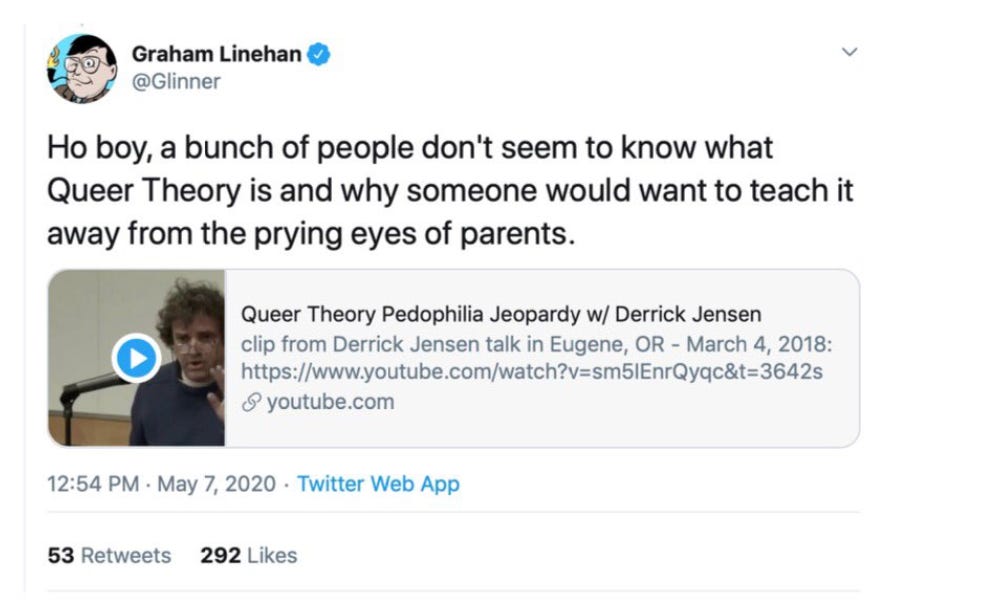
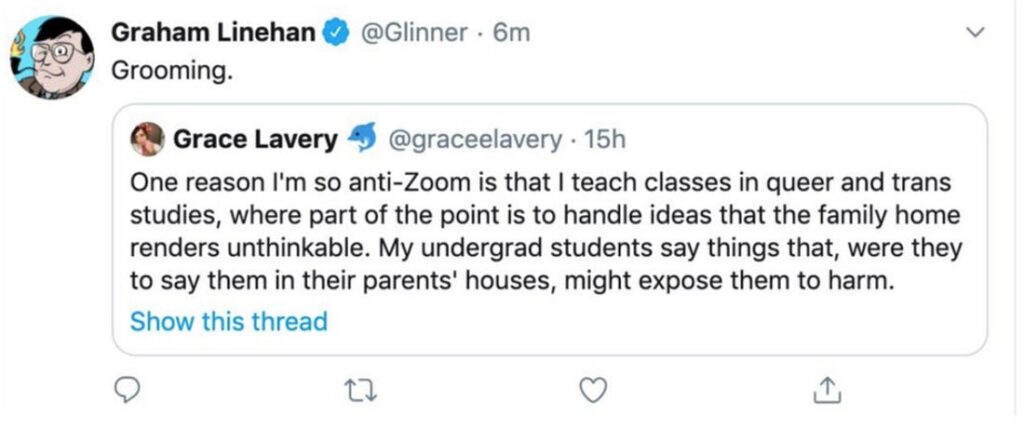
    On May 7th, 2020, Graham Linehan accused me of “grooming” my students at UC Berkeley.

    He then, on Twitter, suggested that I wanted to teach “away from the prying eyes of parents” for nefarious purposes:

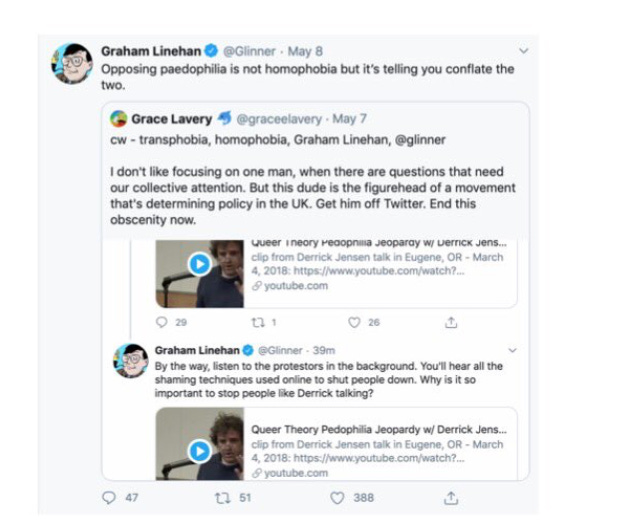
    Finally, on the same day, he referred to queer theory––a branch of the humanities dealing with the cultures and histories of LGBT people––as “paedophilia”:

    I contacted Twitter about these tweets: moderators agreed that they were inflammatory and libelous, and took them down. Linehan’s Twitter account was closed as a result––though he falsely claimed (before the UK Parliament!) to have been censured for a relatively harmless barb he lobbed at the Women’s Institute. 

    To say that the stress of being linked to pedophilia publicly, and being subject to a swarming hate campaign of hundreds of Linehan’s minions, was overwhelming, would be an understatement. All the more so since, at the very same time, my husband and I were engaged in a high-profile campaign for child protection and safeguarding in evangelical churches. To this day, I get hate mail, including accusations of being a “nonce,” from Linehan’s supporters, and I have been subject to an ongoing campaign to get me fired from UC Berkeley––waged by the same people who talk with such pained frankness about “cancel culture.”

    I recently brought myself to watch the video which Linehan kept sharing, of one Derrick Jensen, attempting to discredit queer theory via some reprehensible remarks the French gay writers Michel Foucault and Guy Hocquenghem made about child sexuality in the 1970s. Jensen’s attempt to discredit two of the most important French gay voices of the twentieth century is the very definition of cancel culture, and warrants no engagement. But a further irony is that all I had said was that I taught queer theory (which I do), not that I, personally, accepted every aspect of it (which I don’t). Queer theory has absolutely nothing to do with advocacy of child abuse, but it’s an open question as to whether my own work has much to do with queer theory: I’ve written two essays critical of some of the method’s fundamental principles, “Grad School as Conversion Therapy,” and “Egg Theory’s Early Style.”

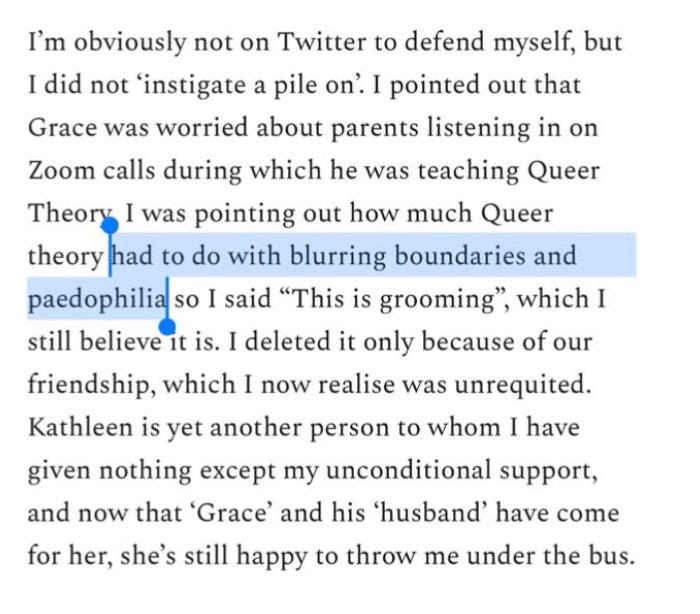
    After having been booted off Twitter, Linehan took to Substack, where he reiterated that he “still believe[s]” my teaching method is a form of “grooming,” because queer theory “ha[s] to do with blurring boundaries and pedophilia.” 

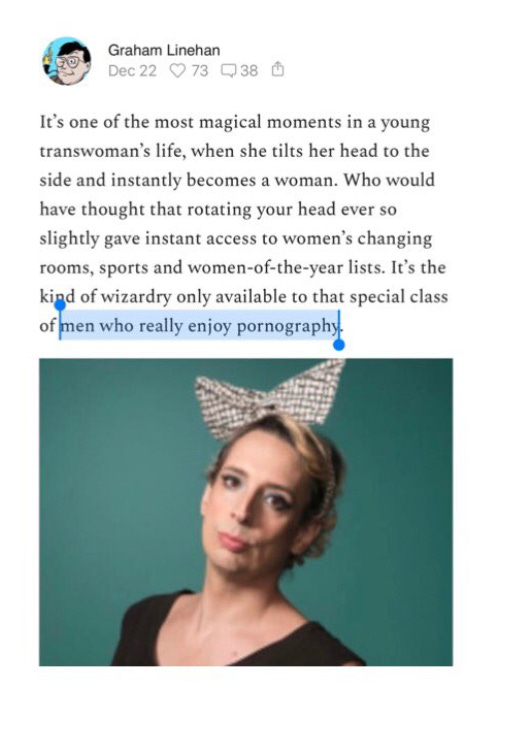
    You will notice that this formulation itself blurs a boundary, between the advocacy of pedophilia and the practice of it. I am guilty of neither, but having persuaded his readers of the first charge, he moves on to the second without difficulty. By December, Linehan was offering even cheaper slurs, such as that I must “really enjoy pornography”:

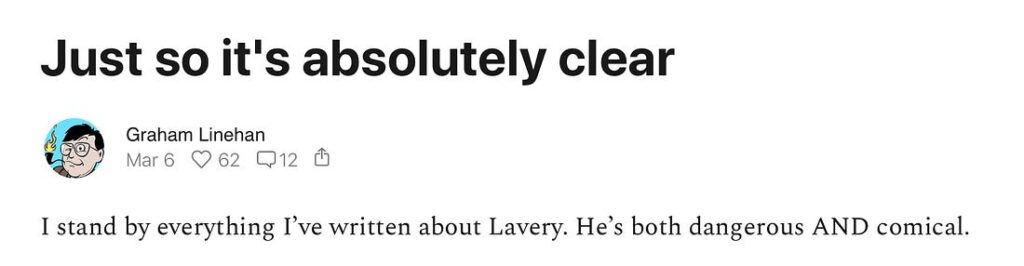
    …which, as it goes, I don’t. Earlier this month, Linehan wrote “I stand by everything I’ve written about Lavery” calling me “dangerous AND comical.” 

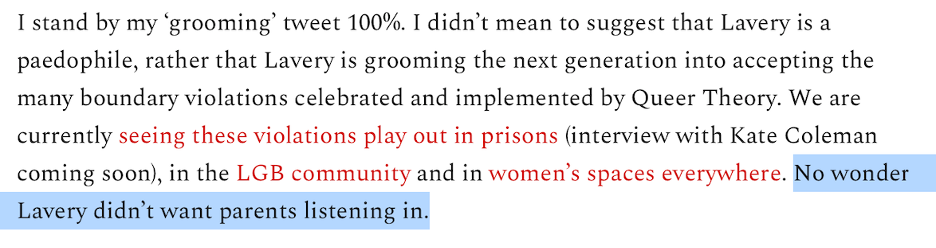
    While he clarifies “I didn’t mean to suggest that Lavery is a paedophile”––he three times uses the same awkward formulation to create just that impression:

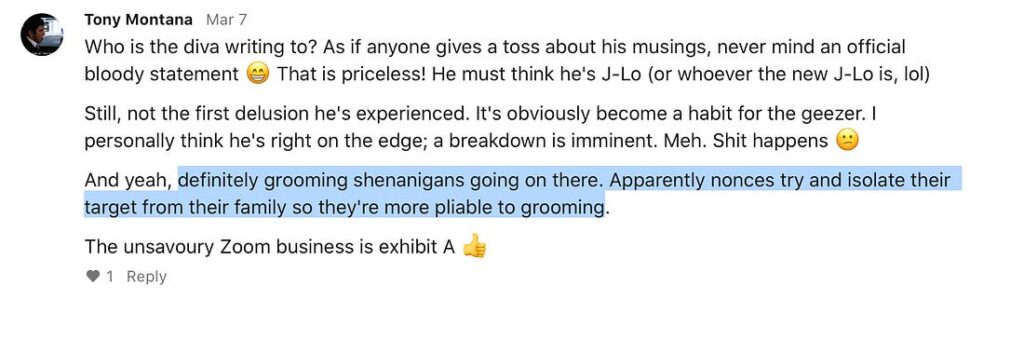
    And of course, his Substack followers knew exactly what he meant: 

    One of the core purposes of a college education is to give students––young adults––opportunities to explore ideas in their own terms, without direct supervision from their families. That is not to say that families of origin are necessarily hostile to the interests of LGBT students––though plenty are––but that education means developing one’s own ideas, one own’s commitments. To cast that as simply the product of predatory designs on the part of educators would be cruel, stupid, and misguided.

    However, it would also be fair comment. That isn’t what Graham Linehan has done. Graham Linehan has waged a campaign, on multiple platforms, to convince his readers that I in particular am a pedophile. They believe him; and as a result I receive hateful, daily harassment. That is wrong, and those who care about “detoxifying” the debate around trans civil rights should have the courage to say so.

    * * *

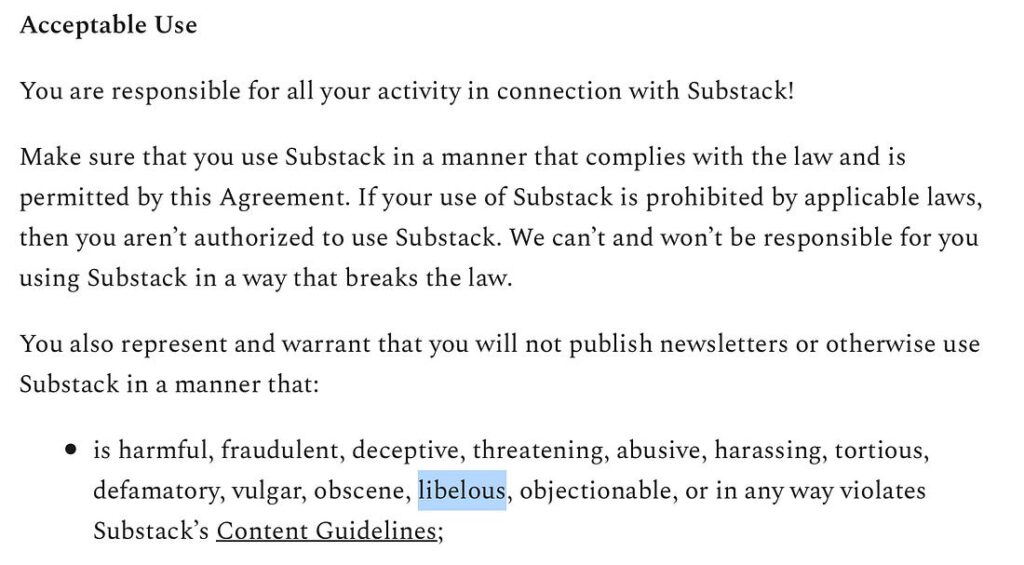
    In December, I contacted Substack to complain about Linehan’s remarks about me, which I held to be libelous, and therefore censurable under the Publisher Agreement (PA):

    They responded that while, of course, they did not believe I was “grooming” my students, nonetheless they were not a courtroom, and could not determine whether or not it was a libel. The implication was that Substack would only remove posts that had already been deemed libelous in court. If that’s all the PA means, the company should be clear about that––indeed, no such document would be necessary, since compliance is assumed.

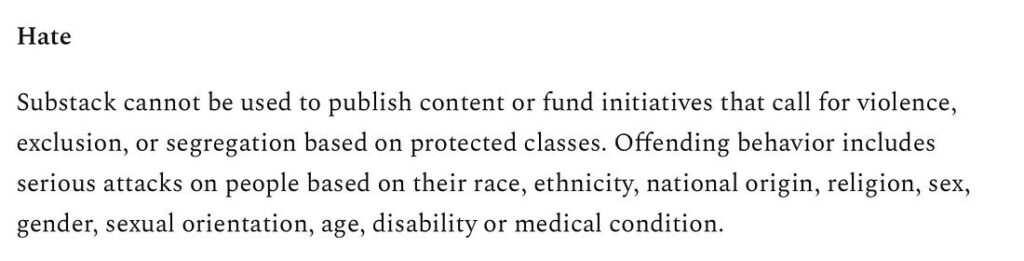
    The section of the Terms of Use (TOU) also includes Content Guidelines, linked to in the PA section excerpted above. Of particular interest here is the prohibition of “hate,” which they define as “serious attacks on people based on their race, ethnicity, national origin, religion, sex, gender, sexual orientation, age, disability or medical condition.”

    Clearly, Linehan’s attack on me is serious. But is it “based on” my sex, gender, or sexual orientation? Yes, self-evidently it is.

    Linehan’s own defense is that contemporary scholars in a field of study deriving from two French gay men is irreparably damaged because of remarks those men made decades ago about childhood sexuality. That defense is homophobic on its face: it is very obviously a “serious attack” based on the presumed “sexual orientation” of practitioners of queer theory. 

    It is also, transparently, false. Foucault’s work on the history of sexuality is certainly influential in queer theory, but no more than in any other number of fields: he is one of the most influential historian of the last century. Hocquenghem is read less frequently today, but his emphatic advocacy of gay identity (not queer) would be temperamentally hard to reconcile with queer theory. I would guess that literally not a single person who works in queer theory today would agree with Foucault’s or Hocquenghem’s views on child consent. Of course I do not, and until Linehan nobody I had ever encountered had ever made this outlandish and disturbing connection. 

    I am wary of walking through the falseness of Linehan’s “argument,” because it is very clear that Linehan neither knows nor cares anything about the subject. His goal is to smear trans people as pedophiles, and he believes that connecting me to Foucault and Hocquenghem will get him there. It is a truly disgusting move. The only basis for such a move is that I am a trans woman, a class of person whom Linehan thinks contemptible, malicious, and undeserving of civil rights.

    It is difficult to think of a more straightforward example of hateful speech act than referring to someone as a pedophile on the basis of their being gay or transgender. This should not, therefore, be a difficult case for Substack. There is no risk of throwing a baby out with this particular trough of sludge. Graham Linehan should not be able to monetize his hatred of trans people, and Substack should not enable him to do so.

    For all of the scapegoating of trans people for cancel culture, often among the more successful adherents of the Substack model (Singal, Glenn Greenwald, Andrew Sullivan, and others), the truth is that the Linehan-like style of vicious, personal attacks on trans people, especially trans women, is the norm rather than the exception. It’s no surprise that trans people online often blame people like Singal and Greenwald for spreading hate, when they profit––directly and indirectly––from the tactics of people like Linehan. And until those people draw a line between their own views and those of the bigots, it is reasonable to assume that they all stand together. 

    (Gosh––yesterday Jesse Singal actually published a piece calling Linehan a “transphobe,” and referred to his conduct against me as “disgusting.” Credit where credit’s due: bravo. Would be good to see similar backbone from Greenwald, Sullivan, and the others.)

    Substack’s media model offloads all editorial responsibility, and most of the financial reward, onto writers. It is a complex idea, and has many advantages over traditional media, while posing particular challenges. Obviously, it has served me well––hence my relaunching my newsletter after a year or so of dormancy. But in order to work as an environment receptive to a diversity of opinion, Substack needs to enforce its own TOU. As the Substack owners recognize, that project depends upon an ability to distinguish between “guard[ing] against harassment” and “censorship.” 

    Linehan harassed trans women on Substack, and he should not be able to poison this community, nor to draw a profit, from his hatred. Freedom of expression is important, and open access is worth fighting for. So are the rights of discussants to talk about complex and controversial topics without being exposed to harm. 

    So close Graham Linehan’s Substack now.


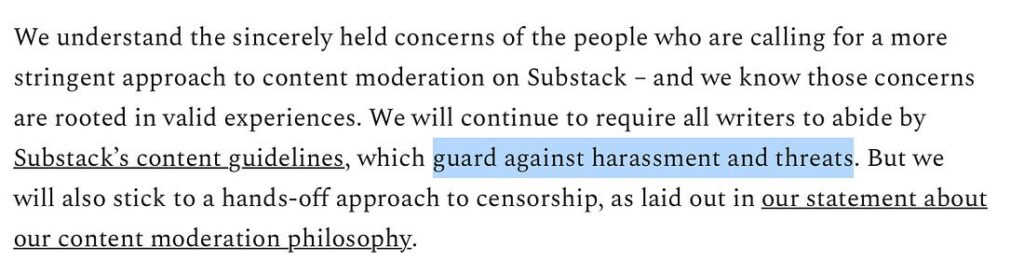
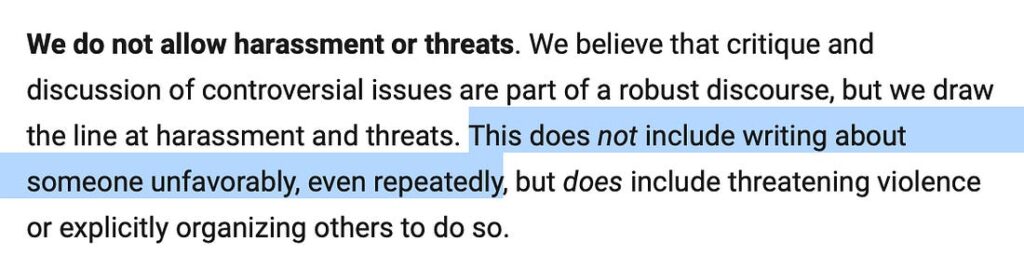
    Update, 03/24/21, 2.45pm: Substack just sent around an email explaining their moderation policy. Though they don’t mention Graham Linehan my post specifically, I kind of think they’re thinking about me, because of this slightly wobbly moment:

    Now, this is a bit odd. The headline is “we do not allow harassment or threats,” a formulation that quite clearly suggests the two are different. They do not say, for example “we do not allow for harassment (ie, threats).” So using “threatening violence” as a definitor of “harassment” makes no sense at all. 

    The decision that Substack wants to avoid making is a difference between fair comment and harassment. Unfortunately for them, since the Substack terms of use explicitly prohibit harassment, they cannot avoid making that determination. 

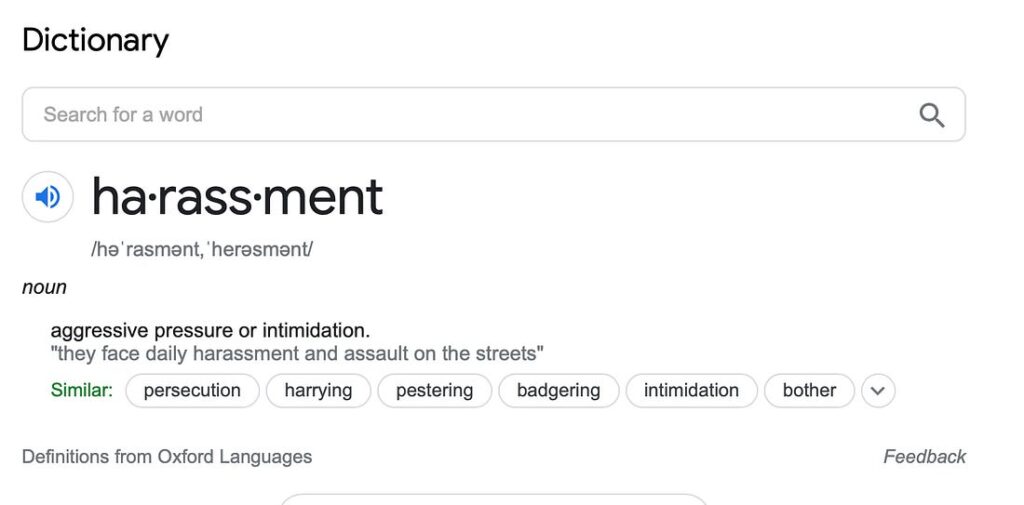
    So what does the word mean? I’m sure some lawyers have more precise ideas than me, but here’s a quick google result:

    Is Linehan aggressive? Does he apply pressure? Does he aim towards intimidation? Yes, yes, and yes. 

    The statement from Substack also fails to respond to my point about libel. Is it truly the case that Substack will only judge a statement to be libelous if directed to do so by a court? If so, they should make that clear.

    ∿

  • My Words to Joanne Rowling Above the Towers of Hogwarts: Performing Transgender Civility

    Dear Joanne,

    I want to begin by sharing my disgust with those––starting with The Sun––who have escalated misogynistic attacks upon you in the wake of your recent disclosures of opposition to the movement for trans civil rights. While I disagree with your position emphatically and unapologetically, and it is the primary purpose of this letter to explain the substance of that disagreement, it is beyond doubt that many people who believe themselves to be supporting trans women have targeted you unfairly. I join, then, with Roz Kaveney, Andrea Lawlor, and the dozens of other trans people who signed a letter of support for you after The Sun had published a story under the headline “I slapped JK and I’m not sorry” earlier this year. Such an alarming display of misogynist power gives the lie, in my view, to the notion that “terf” is, intrinsically, a sexist slander: at least, it was not one that The Sun had any need for, when it decided to exercise that power against you. 

    I want also to name another point of agreement between us: as you explain in your oddly-titled essay “J. K. Rowling Writes about Her Reasons for Speaking out on Sex and Gender Issues,” our experiences are not the same. It is difficult to find much that I have in common with you––although, like someone quite close to you, I was a child from a lower-middle-class family who, at the age of 11, moved into a magical world of selective education, and gained access to social circles and cultural capital that nobody had heard of in the house in which I’d grown up. Like The Chosen One, I found that my being an outsider emanated a certain ambivalence, in me and in those around me: I found  it easy to hold people’s attention, though perhaps not as easy as the hero of Hogwarts. Still, partly because of the psychic consequences of those experiences, and partly for their ramifications across an entire social domain, I cannot romanticize selective education, nor the Government Assisted Place scheme upon which the ward of Dursley would have depended had he been admitted to King Edward’s School, Birmingham. 

    The remainder of this letter, which concerns civility––indeed, has been written in order to endorse and uphold the noble goal of discursive civility to which you have committed yourself––must, I am afraid, make clear what I take to be very serious errors of judgment in your handling of this matter. In some cases, those errors of judgment stem from errors of fact. You write early on, for example, that your absorption into your present circumstances was occasioned by tweeting your “support for Maya Forstater, a tax specialist who’d lost her job for what were deemed ‘transphobic’ tweets.” Although the single quotation marks around “transphobic” make clear that you are not quoting from anywhere, it isn’t clear to this reader, at least, whether you believe the tweets in question to deserve that description––my inference is that you do not. 

    You go on to describe Forstater’s tweets as part of “a philosophical belief that sex is determined by biology.” In fact, the clause might indicate either of three things: either (1) a belief that sex as determined by biology is protected in law, (2) a belief that sex is determined by biology as protected in law, or (3) whether “a belief that sex is determined by biology” is protected in law (the question in the latter case being whether such a belief would be protected in law becauseit was right, or simply because it is a belief, and beliefs are protected in law). The question of whether law or biology comes first, a position on which is quite difficult to extract from your sentence as published, is of course the central question of the very debates in feminist philosophy (in the work of, for example, Catherine McKinnon and Judith Butler) that the current “gender critical feminists” either have not read, or act as though they have not read. 

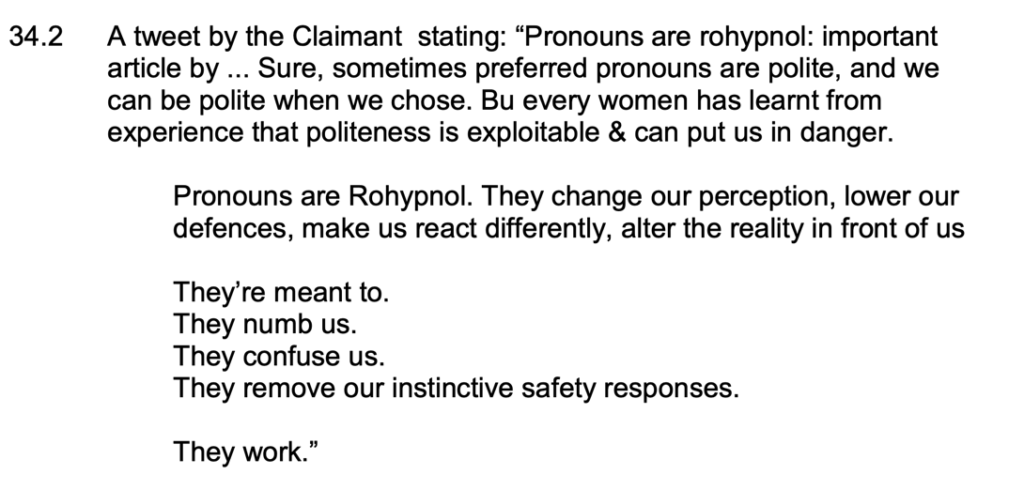
    Still, one thing is eminently clear: neither of these “beliefs,” whether or not they could be attributed to Maya Forstater, adequately describes either the letter or the spirit of the tweets for which her contract was not renewed, and which were primarily at issue in her claim against the Center for Global Development, decided against her in November 2019. The full decision, including the texts of the tweet, has been uploaded to Snopes, the website for debunking online misinformation, since Forstater herself (and now you) have been responsible for such grotesque distortions of it. In particular, I would call your attention to the tweet cited in the decision in §34.2, in which Forstater quote-tweeted, with approval, an article entitled “Pronouns Are Rohypnol”: 

    Maya Forstater tweet: "Pronouns are rohypnol"

    We may save ourselves the usual fruitless debate over whether a retweet constitutes an endorsement, since in this case Forstater has made it clear what is her view of “Pronouns Are Rohypnol”: it is an “important article.” Now, you are perhaps free to think that this alarming analogy is not “transphobic,” but in that case I suspect you would find yourself in the minority. Perhaps you think that, despite being transphobic, it should not be grounds for contract non-renewal: on this point, you might find broader agreement. But you certainly cannot think, unless you happen not to have read the Forstater decision, that the tweets for which her contract was non-renewed were anything to do with “a philosophical belief.” They were abusive tweets, quite simply meant to shock, hurt, and frighten women. 

    It will appear unseemly to dwell on the vicious online behavior of one troll––albeit a troll who seems to have had the dubious privilege of radicalizing the wealthiest writer in the world, possibly in history. But it is the central importance of “pronouns are rohypnol” to the ongoing “debate” (I do quote you: “the debate around the concept of gender identity”) can hardly be overstated. The apparent meaning of the phrase, which is indeed the one developed in the essay “Pronouns Are Rohypnol” by Barra Kerr, published on the Fair Play for Women website: basically, that when trans people ask others to refer to us by particular pronouns––and more specifically, when trans women do so––we are, in essence, disarming people of their power to fight us off. “Rohypnol,” then, because trans women are analogous to rapists: all we want is to gain sexual intimacy with women by force––this, the “gender critical” team has it, is the compulsive condition called “autogynephilia.” And pronouns are one among many techniques with which trans women may carry out our work of silencing dissent, the better to prey on unsuspecting women. 

    This plain sense of “Pronouns Are Rohypnol,” of course, rather gives the lie to the notion that trans people are uniquely rude or cruel in our participation in what you call the “debate” over our civil rights. Indeed, I think trans civil rights activists should not be discredited on the basis of occasionally sharp words, mostly from teenagers. Believe me, I have also been called cunt and bitch––and addition, I have also been called rapist, in that case by the person you have made it your vocation to defend. And explicitly pedophile, by Graham Linehan, one of the primary signatories of another recent letter in support of you, and by his many defenders, enablers, and excusers, including Jane Clare Jones––who still, I believe, does events with Linehan––and Kathleen Stock, who, after initially having the courage stand up to his ludicrous bullying, and call libel by its name, eventually said she regretted his having been expelled from Twitter for it because, after all, it was just a little rough-housing. Unlike you, Joanne, I have access to neither billions of pounds to comfort and protect me, nor the telephone numbers of the British Establishment from whom I might expect a letter of public support. When the creator of Father Ted publicly accuses me of “grooming” my own students at UC Berkeley, on the basis of my having expressed concern for LGBTQ students currently living at home in perhaps unsupportive families, I have no defense open to me––a beloved former mentor, who knows thankfully little about this whole mess, wrote to me to express concern about Linehan’s accusation, assuming that a person of his eminence would not identify smoke were there not also fire. So I sympathize––indeed, if you will forgive my use of the forbidden verb, I identify––with the “millions of women whose sole crime is wanting their concerns to be heard without receiving threats and abuse.”

    You will notice, Joanne, that I have not yet addressed the apparent substance of your essay: the “philosophical belief” you impute to Maya Forstater that “sex is determined by biology.” You flesh out this argument a little later:

    I’ve read all the arguments about femaleness not residing in the sexed body, and the assertions that biological women don’t have common experiences, and I find them, too, deeply misogynistic and regressive.

    Since you don’t say which arguments you’ve read (all of them?) I can hardly respond in detail: indeed, a significant part of my point here is that the supposed philosophical debate that is being silenced (concerning the meanings of something called “biological sex”) is both less censored, and much less interesting, than advertised. It is difficult to know how best to respond to the above bluster––perhaps by attempting to distinguish, as Judith Butler has so conscientiously done, between the body as a material object; the body as it presents itself to consciousness; the body as it is “sexed,” to use your passive construction (which, I take it, indeed derives from Butler); the body as its biological features are assigned particular kinds of taxonomic significance and legibility; the unpredictable effects and distinctions of those meanings as they change over time. Discriminations of this kind are usually necessary to any philosophical analysis of sex (not gender) in both analytical and Continental philosophical traditions: one can hardly characterize a body of knowledge that stretches back over a century, and has shaped the thoughts of millions upon millions of women, as “misogynist,” without sounding a little like one of those politicians who confesses himself sick of “experts.” 

    Less useful as scholarship than as ideology––as the mark of how a certain social class understands itself and represents itself at this moment in history––“J. K. Rowling Writes” is indispensable. It perfectly depicts a dishonest and insecure oligarchy, desperate to control access into its own terrains and repel invaders at the border. Though its author may have felt otherwise, “J. K. Rowling Writes” is the document of the Brexit era: a text that could rival the present Prime Minister for evasiveness, philosophically incoherence, and a liability to cover up felt intellectual inadequacy with bluff, unfunny jokes: “a lot of people in positions of power really need to grow a pair (which is doubtless literally possible, according to the kind of people who argue that clownfish prove humans aren’t a dimorphic species).”

    I want to conclude with a contention of my own, for which I have no more evidence than a hunch and a few dozen conversations and anecdotes shared with my friends and allies in the LGBTQ community against whom, for whatever reason, you have declared war. We mostly don’t care whether “trans women are women,” and we have many positions on that. We mostly don’t care whether femaleness resides in the sexed body, or what “femaleness” is, or what “the sexed body” is, or what it means for a property to “reside” in a predicated object. We simply don’t believe you when you claim not to be transphobic, not because of these positions, but because of your failure to notice that your apparently blameless movement of frustrated common-sensers, has been infiltrated at every level by the kind of vicious, hostile bigots whose entire business is to defame and degrade the lives of trans women. From Maya Forstater to Graham Linehan, through the Heritage Foundation to WoLF, you have failed to address the hatred in your own ranks, and it is for that reason, and nothing to do with your banal opinions, that you must be called to account. 

             Best wishes,

             Grace Lavery

    ∿

  • Grad School as Conversion Therapy

    Los Angeles Review of Books ∿ October 29, 2018